Coloured Pencils
Faber-Castell Goldfaber Coloured Pencils Reviewed
Faber-Castell Goldfaber coloured (colored) pencils reviewed: firm enough for detail, soft enough for shading, and an introduction to the feel of Polychromos.
This guide contains affiliate links. If you buy through them we may earn a small commission at no cost to you. How this works.
Jump to recommended products
Key takeaways
- ◆Goldfaber is firm enough for detail and soft enough for shading, which makes it a balanced all-round pencil.
- ◆Michael describes it as a great introduction to the feel of Polychromos.
- ◆It is Faber-Castell's more accessible range, so it suits artists who want firmness without stepping straight up to a professional set.
- ◆Being firmer than soft wax pencils, it gives more control but less buttery blending.
- ◆Check the current range, and the lightfastness ratings of the colours you use, before selling work.
Faber-Castell Goldfaber sits in a useful middle position. It is firm enough for detail, soft enough for shading and, in Michael’s words, a great introduction to the feel of Polychromos. If you want a pencil that behaves a little like a professional firm pencil without starting at the top of the range, this is the obvious place to look.
This review of Goldfaber coloured pencils (colored pencils in the US) covers how they feel, how to use them, who they suit and how they compare with Polychromos. We keep to what Michael’s notes and widely known facts support, so check the current range and specifications before buying. For background, read our complete coloured pencil guide and try the pencil set quiz if you are still deciding.
What Goldfaber is
Goldfaber is Faber-Castell’s more accessible coloured pencil range. Michael’s short description is that it is firm enough for detail, soft enough for shading, and an introduction to the feel of Polychromos. Faber-Castell is the same maker behind Polychromos, so the family resemblance is deliberate: a firmer pencil with a controlled laydown rather than a buttery one.
That places it between soft wax pencils and the professional oil-based line. It is not as creamy as Prismacolor Premier or Coloursoft, and it is not the professional-grade line that Polychromos is. Think of it as a first step into firmer pencils. For the difference between wax and oil in general, read wax vs oil-based coloured pencils.
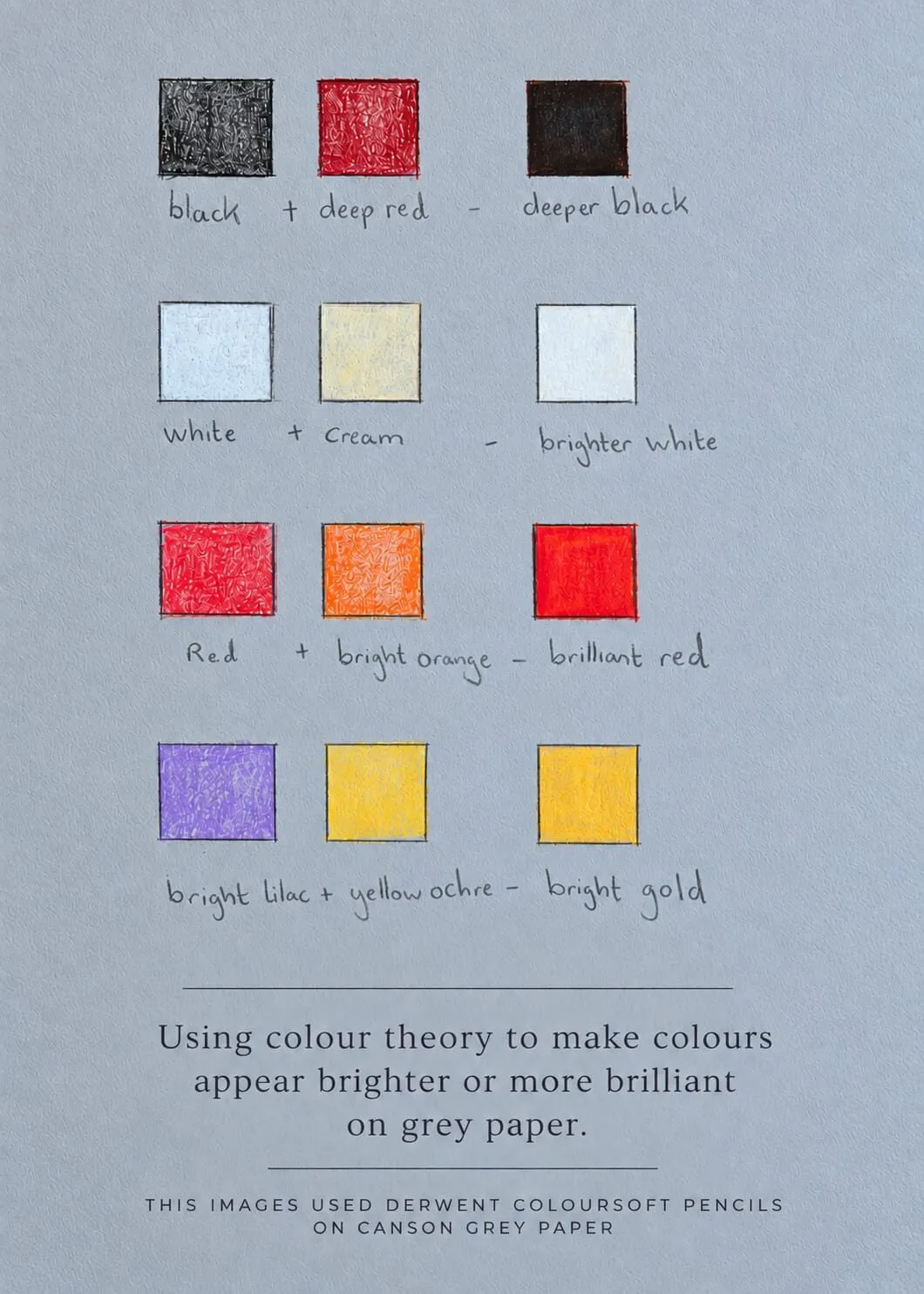
A hand-drawn swatch card on grey paper showing colour pairings: black with deep red, white with cream, red with bright orange, and bright lilac with yellow ochre. Drawing by Michael Brace.
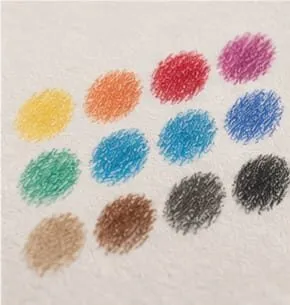
Round swatches of coloured pencil in yellow, orange, red, pink, green, blue, brown and black on cream paper.
How it feels and behaves
Goldfaber feels controlled. The core holds a point longer than very soft pencils, so crisp lines and small shapes are easier. It still shades, so you can build smooth tone with light, even layers.
Practical strengths:
- Point control. A sharpened point holds up well for edges and small marks.
- Predictable layering. Firmer cores fill the paper’s tooth more slowly than very soft ones, so more layers are possible.
- Even shading. Light pressure gives gentle tone that builds steadily.
- A teaching feel. You learn to build colour in thin layers, the habit that professional firm pencils reward.
The trade-off is that blending is less buttery than with soft wax pencils, and covering large areas takes more passes. If you enjoy fast, creamy coverage, compare with Chromaflow or Coloursoft.
Layering and blending
Firm pencils reward patience. Use several light layers rather than one heavy one, working from light to dark.
- Sharpen well. A fresh point gives cleaner lines and more even tone.
- Layer lightly. Build colour in thin passes, varying the direction of your strokes.
- Use the side of the point for broad tone and the tip for edges.
- Blend by overlaying related colours rather than expecting a melt as with wax.
- Burnish at the end if you want a smoother finish.
For method, see how to layer coloured pencils and how to burnish coloured pencils.
Best subjects
Goldfaber suits subjects that mix detail with moderate shading.
- Animals and pets. Fur, feathers and whiskers benefit from a firm point. See how to draw animal fur and how to draw a dog.
- Still life. Crisp edges and controlled highlights on objects.
- Botanical and natural forms. Small, precise shapes and fine veins.
- General learning. Practice pieces that teach layering, value and colour mixing.
It is less suited to fast, soft, painterly coverage of large areas. For those, softer wax pencils do more with less effort.
Paper pairings
Firm pencils depend on tooth, because they deposit colour more slowly.
| Paper type | What to expect |
|---|---|
| Smooth hot press | Clean detail; fills sooner, so keep layers light |
| Lightly textured or mixed media | Good grip and more layers; slightly grainier finish |
| Toned or grey | Firm pencils cover less opaquely, so add light layers to build highlights |
For recommendations, see best paper for coloured pencils, paper tooth: smooth vs textured and best drawing paper for beginners.
Goldfaber vs Polychromos
Goldfaber is the accessible introduction; Polychromos is the professional line. The key points:
| Point | Goldfaber | Polychromos |
|---|---|---|
| Position | More accessible Faber-Castell range | Professional oil-based range |
| Feel | Firm, with enough softness to shade | Firmer, with crisp layering |
| Range | Check the current range | 120 colours |
| Lightfastness | Check per-colour ratings | Excellent overall, a few vary slightly |
| Best for | Learning, general use | Detail, many layers, selling work |
The full comparison is in Faber-Castell Polychromos vs Goldfaber. If you want to see where Goldfaber fits among other options, best coloured pencils and professional vs student coloured pencils give the wider picture.
Who it suits
- Beginners who want firm control and a teaching feel, as Michael’s picks suggest.
- Improvers moving from very soft pencils who want more precision.
- Budget-conscious artists who want firmness without a professional price tag; check current pricing.
- Polychromos curious artists who want to try the feel before investing.
Who should look elsewhere: artists selling work who need verified top-tier lightfastness, and those who want buttery blending above all.
Buying advice
Sets come in small, mid and large sizes; check the current range. A small or mid set is ideal for learning, and how many coloured pencils you need explains why a limited palette often teaches more. Consider open stock for whites and darks. If you plan to sell, check the lightfastness information for each colour, and read coloured pencil lightfastness explained.
A practice routine for firm pencils
Firm pencils suit a disciplined approach, and a short routine builds the habits that carry over to professional ranges.
- Pressure scale. Draw a strip and move from the lightest touch to firm pressure in even steps. Note how many distinct tones you can make.
- Layer test. Lay three thin layers of one colour in different directions, then compare the result with one heavy layer. The thin layers will look smoother and leave the tooth open.
- Edge control. Draw a small shape, such as a leaf or an eye, using the tip for the outline and the side for the fill.
- Two-colour mix. Overlay two related colours and check how they combine, then reverse the order.
- Value check. Convert a finished study to greyscale, or use our value study tool, to see whether the darks are dark enough.
These small exercises teach point control, light layering and value, the skills that matter most once you move to Polychromos. They also show you early whether you enjoy the firm, controlled style, which is the real question a first Faber-Castell set answers. Our lessons on how to blend coloured pencils and how to draw basic forms and shading fit the same routine.
Limits to know about
Every pencil has trade-offs, and Goldfaber’s are the expected ones for a firm, accessible range.
- Not the softest blender. If you want to flood colour across a large area with buttery ease, a soft wax pencil does it faster.
- Fewer layers than a professional firm pencil. Goldfaber suits learning and general use, while professional ranges are designed for many clean layers and selling work.
- Lightfastness varies by colour. Check Faber-Castell’s published information before selling a piece.
- Range size. Check the current range to see whether the hues you need are available, and whether open stock is offered.
None of these is a reason to avoid the pencil. They are reasons to choose it for the right job: learning firm technique, drawing detailed subjects at a sensible cost and discovering whether Polychromos is your next step.
When to step up to Polychromos
Consider moving up when you want a wider choice of exact hues so that you mix less, when you start selling or exhibiting and want professional lightfastness, or when your drawings call for many clean layers that keep a crisp finish. Polychromos offers a 120-colour range and is excellent on lightfastness overall, though a few colours vary slightly. Keep your Goldfaber pencils for practice, studies and travel sketching, since nothing forces you to abandon them. The Polychromos review explains what the upgrade involves.
The short version
Faber-Castell Goldfaber is firm enough for detail and soft enough for shading, and it is a great introduction to the feel of Polychromos. It is the accessible Faber-Castell range, good for learning and general use, and it suits animals, still life and careful layering. If you want top lightfastness and a large range, step up to Polychromos; if you want buttery blending, look at soft wax pencils. The quiz can help you decide.
Where to buy
Recommended products
Affiliate links. We may earn a small commission if you buy, at no extra cost to you. Why?
Pencils · Faber-Castell
Faber-Castell Goldfaber
Firm enough for detail, soft enough for shading - an accessible introduction to the feel of Polychromos.
Quick answers
Frequently asked questions
Is Faber-Castell Goldfaber good for beginners?+
Yes. Michael lists Goldfaber among his beginner picks: firm enough for detail, soft enough for shading, and an introduction to the feel of Polychromos. It teaches light layering and point control without the crumbly softness of some wax pencils. Check the current range for set sizes.
What is the difference between Goldfaber and Polychromos?+
Goldfaber is Faber-Castell's more accessible range and gives a taste of the firm, controlled Polychromos feel. Polychromos is the professional oil-based line, with a 120-colour range and excellent lightfastness overall. Goldfaber suits learning and general use; Polychromos suits serious detail and many layers.
Can I use Goldfaber for detailed work?+
Yes, it is firm enough for detail and holds a point reasonably well, so fine lines, small shapes and controlled edges are achievable. For the finest hair, whiskers and intricate work on many layers, a professional firm pencil such as Polychromos gives more consistency and lightfastness.
Are colored pencils and coloured pencils the same thing?+
Yes. Coloured is the UK spelling and colored is the US spelling of the same drawing medium. Faber-Castell Goldfaber pencils are the same product whichever spelling a shop or search uses, and this review applies to both.