Coloured Pencils
Faber-Castell Polychromos vs Goldfaber
Faber-Castell Polychromos against Goldfaber coloured (colored) pencils: feel, detail, layering, who each suits and when the upgrade is worth it.
This guide contains affiliate links. If you buy through them we may earn a small commission at no cost to you. How this works.
Jump to recommended products
Key takeaways
- ◆Goldfaber is Faber-Castell's more affordable range: firm enough for detail, soft enough for shading, and an introduction to the feel of Polychromos.
- ◆Polychromos is the artist range: oil-based and firm, known for precision, clean layering, sharp points and consistent behaviour, with 120 colours.
- ◆For a beginner who wants firm, controllable pencils, Goldfaber is a sensible first step; for many-layered realism and exhibition work, Polychromos is the stronger choice.
- ◆The upgrade matters most when you draw fine detail, build many layers or plan to sell or exhibit; check each maker's lightfastness information for your colours.
- ◆Check the current range and set contents for both before buying, as they change.
Faber-Castell makes two coloured pencils - colored pencils in the US - that beginners and returning artists often weigh against each other: Goldfaber and Polychromos. They come from the same maker and share a family resemblance, but they are positioned for different stages of drawing.
This comparison explains how they differ, who each suits, and when moving up to Polychromos actually makes a visible difference. It sits within our complete coloured pencil guide. We keep to well-established characteristics and Michael’s assessments, and we send you to Faber-Castell for current colour lists, set contents and prices.
The quick verdict
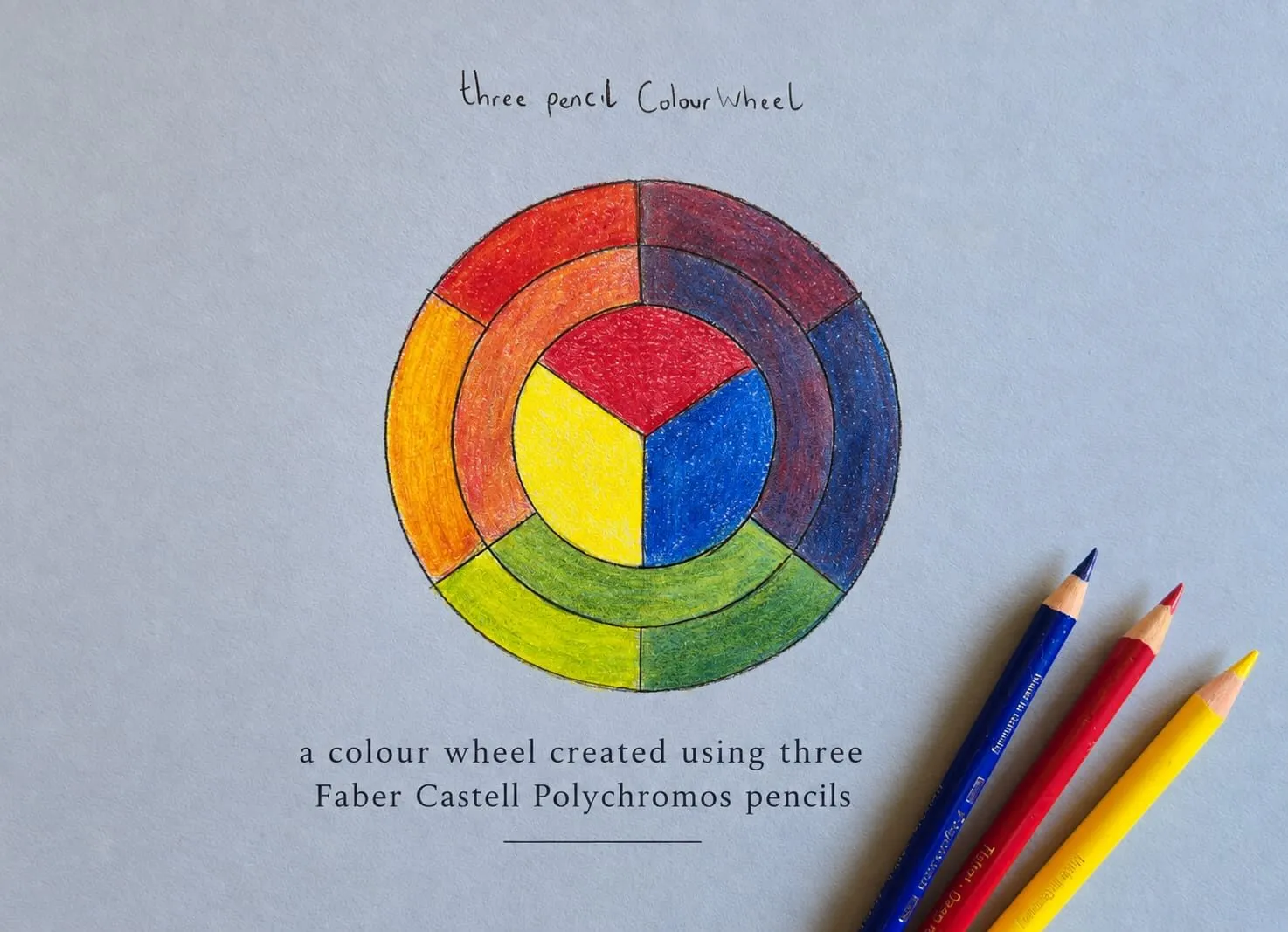
A hand-drawn colour wheel made with three Faber-Castell Polychromos pencils on blue-grey paper. Drawing by Michael Brace.
Side by side
| Feature | Goldfaber | Polychromos |
|---|---|---|
| Positioning | More affordable range | Artist range |
| Feel | Firm enough for detail, soft enough for shading | Firm, precise, oil-based |
| Layering | Good for learning layers | Clean, many layers |
| Points | Holds a workable point | Holds a sharp point |
| Consistency | Check the current range | Consistent behaviour across the range |
| Colour range | Check the current range | 120 colours |
| Price level | Lower | Higher (check current listings) |
| Best for | Beginners, students, casual drawing | Detail, wildlife, still life, exhibition work |
What Goldfaber is
Goldfaber is Faber-Castell’s more affordable coloured pencil range. Michael’s description sums it up well: firm enough for detail, soft enough for shading. That balance is what makes it a good learning pencil. It lets you practise pressure control, layering and shading without the frustrations of a very soft core that breaks or a very hard one that will not build colour.
It is also, in Michael’s words, a great introduction to the feel of Polychromos. If you like how Goldfaber handles, you will recognise the family character in Polychromos, only more refined.
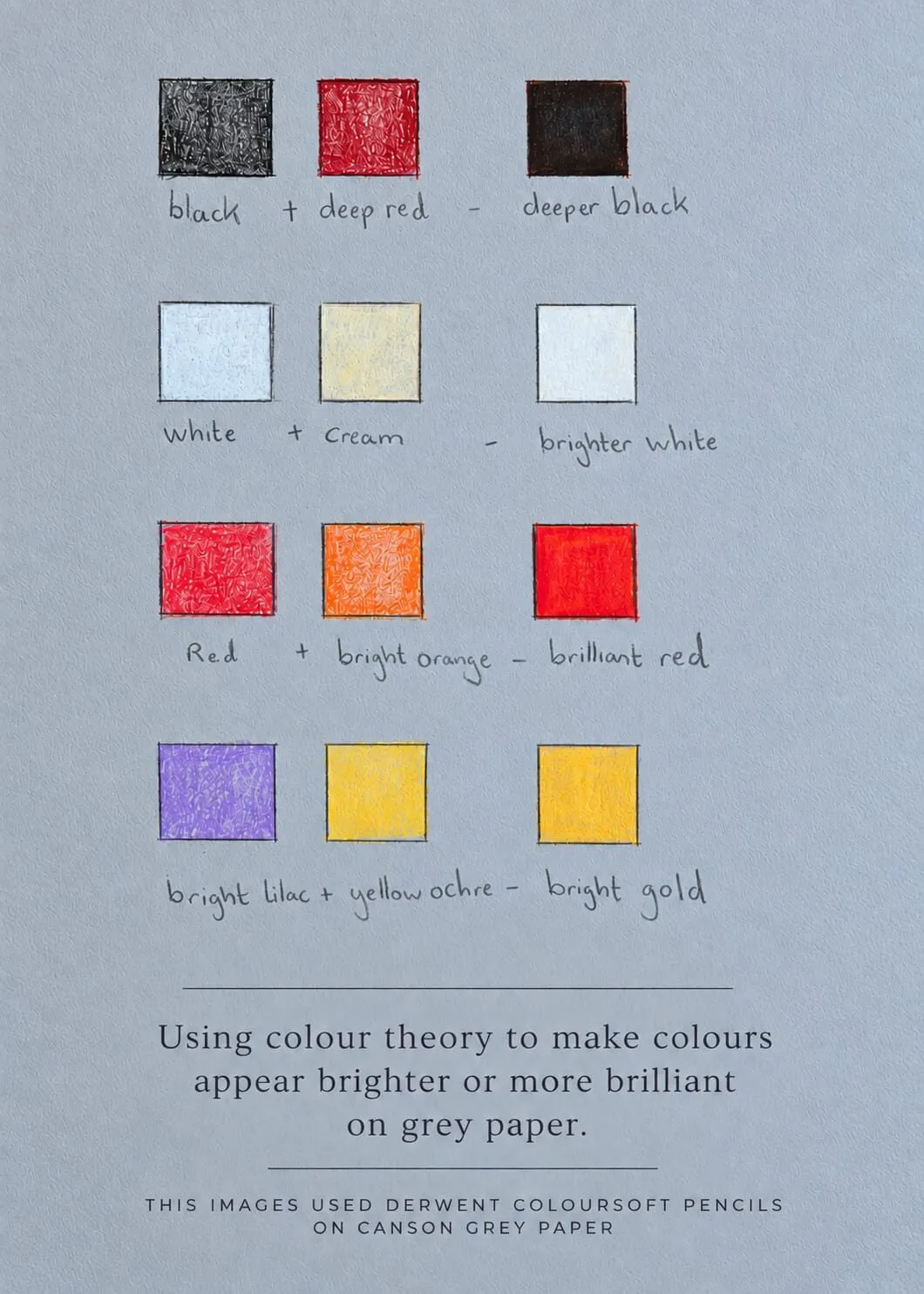
A hand-drawn swatch card on grey paper showing colour pairings: black with deep red, white with cream, red with bright orange, and bright lilac with yellow ochre. Drawing by Michael Brace.
What Polychromos is
Polychromos are Faber-Castell’s professional coloured pencils. They are oil-based and firm, and they are known for precision, clean layering, sharp points, excellent detail control and consistent behaviour across the range. They are especially popular among wildlife and still-life artists. The range is wide, at 120 colours, so matching subtle hues is easier.
For more depth, see our Faber-Castell Polychromos review.
Where you feel the difference
Without inventing test results, here is where an artist-grade pencil generally justifies itself.
Detail and sharpness
Firm, oil-based pencils hold a point and let you draw fine lines for longer. That is why Polychromos are favoured for fur, feathers, hair, eyelashes and crisp edges. Goldfaber is firm enough for detail, so beginners can still work small, but artist-grade pencils are built for sustained precision.
Layering
Layering is the backbone of realism. Polychromos allow many clean layers because the firm core does not clog the tooth quickly. Goldfaber handles layering for learning and moderate work. If you push a drawing through dozens of layers, the extra control of an artist-grade pencil starts to show. See how to layer coloured pencils.
Colour range and consistency
A wide range gives you more choice and fewer mixing compromises, particularly for skin tones, earth colours and greys. Polychromos have 120 colours. For Goldfaber, check the current range. If you mix your own colours by layering, both can work, but a larger palette saves time on complex subjects. Our guide on how to match and mix colours with pencils shows how to get more from a smaller set.
Lightfastness
Lightfastness is how well colours resist fading. Polychromos are excellent overall, with a few colours varying slightly. Both ranges publish lightfastness information, and ratings are per colour, so check the maker’s charts for the specific pencils you use. This matters little for sketchbook practice and a great deal for work you sell or hang in a bright room. Read coloured pencil lightfastness explained for how to read the ratings.
Which is better for which subject?
| Subject | Goldfaber | Polychromos |
|---|---|---|
| First lessons and practice | Excellent | Good, if budget allows |
| Portraits | Fine for learning | Better for eyes, hair, skin variety |
| Wildlife and fur | Fine for learning | Best, sharp points and range |
| Still life and metal | Good | Best for crisp edges and clean layering |
| Selling or exhibiting | Not the usual choice | Common professional choice |
| Very smooth, blended skies | Fine | Possible with layering, slower than soft pencils |
When does the upgrade matter?
The upgrade to Polychromos matters when one or more of these is true:
- You keep running out of colours in your set, especially for skin, earth tones and greys.
- You draw fine detail such as fur, feathers, hair or textured surfaces.
- Your drawings involve many layers and you want them to stay clean.
- You sell, exhibit or gift your work and want reliable lightfastness information for your colours.
If none of these apply, Goldfaber may be all you need for now. Spending on paper first can improve your results more than upgrading pencils; see best paper for coloured pencils.
Getting the most from either range
Whichever you choose, technique and setup change the result as much as the label on the barrel. Sharpen with a good sharpener so the firm core is not damaged, and keep the point long enough for fine work; see how to sharpen coloured pencils. Use light pressure at first and build colour in thin layers, saving heavy pressure for the end. Work on paper with enough tooth and weight to accept many layers.
A sensible way to learn the difference yourself is to draw the same small subject twice, once with each range, on the same paper. Compare how many layers each takes, how long the point lasts, and how close you can get to the colours you see. That personal comparison is worth more than any review.
Do you need a soft pencil too?
Both Faber-Castell ranges are firm enough that they are not the easiest for very smooth, painterly blending. Many artists add a softer pencil for broad areas and keep the firm ones for detail. Our comparison of Prismacolor versus Polychromos explains that split in detail.
Keep your expectations realistic, too. A more expensive pencil does not draw for you, and a learner with Goldfaber and good habits will beat a careless artist with the finest set. The upgrade removes limits; it does not create skill.
Recommendation by budget and experience
- Lower budget, beginner: Goldfaber in a smaller set is a sensible start. It teaches control and layering and sets you up for Polychromos later.
- Medium budget: a smaller Polychromos set, or Goldfaber plus a few well-chosen extra colours, depending on how much detail you draw.
- Higher budget or serious realism: Polychromos in a larger set, with a good sharpener and paper to match.
Set sizes and contents change, so check the current range before you buy. Our best coloured pencils for beginners guide covers the wider beginner field.
The short version
Goldfaber is the more affordable range: firm enough for detail, soft enough for shading and a friendly introduction to the feel of Polychromos. Polychromos are the oil-based, artist-grade pencils with 120 colours, sharp points and clean layering for serious detail and exhibition work. Start with Goldfaber if you are learning; move to Polychromos when detail, range and layering become your limits.
Where to buy
Recommended products
Affiliate links. We may earn a small commission if you buy, at no extra cost to you. Why?
Pencils · Faber-Castell
Faber-Castell Polychromos
Firm, oil-based artist pencils that hold a point - a benchmark for detail and clean layering.
Pencils · Faber-Castell
Faber-Castell Goldfaber
Firm enough for detail, soft enough for shading - an accessible introduction to the feel of Polychromos.
Quick answers
Frequently asked questions
Is Goldfaber as good as Polychromos?+
Goldfaber is a good pencil, but it is positioned as the more affordable range and an introduction to the feel of Polychromos. Polychromos is the artist-grade line, known for precision, clean layering and consistency across a wide colour range. For casual drawing, Goldfaber is often enough; for demanding work, Polychromos gives more.
Is Goldfaber a good beginner pencil?+
Yes. Michael lists Goldfaber among the best beginner options because it is firm enough for detail and soft enough for shading. It teaches pressure control and layering with a pencil that behaves predictably, and it prepares you for the feel of Polychromos if you upgrade later.
Are Polychromos worth the extra cost?+
They are worth it if you draw fine detail, build many layers, or want reliable colour across a wide range, including for work you plan to sell. If you draw casually or are still learning, a more affordable range may be all you need. Check current prices and choose by how much you draw.
Are colored pencils and coloured pencils the same?+
Yes. Colored is the US spelling and coloured the UK spelling of the same product. Polychromos and Goldfaber are sold under both spellings, so a search for either term will lead to the same Faber-Castell ranges and the same kinds of set.