Coloured Pencils
Prismacolor vs Polychromos
Prismacolor Premier (soft, wax-based) against Faber-Castell Polychromos (firm, oil-based): coloured (colored) pencils compared by blending, detail, breakage and subject.
This guide contains affiliate links. If you buy through them we may earn a small commission at no cost to you. How this works.
Jump to recommended products
Key takeaways
- ◆Prismacolor Premier is soft, wax-based and creamy: it lays down rich colour quickly and blends easily, but the softer core breaks more readily and heavy layering can bring wax bloom.
- ◆Polychromos are oil-based and firm: they hold a sharp point, layer cleanly and suit crisp edges, fine detail and many layers.
- ◆Choose Prismacolor for smooth, painterly blending and quick bold colour; choose Polychromos for wildlife, still life and precise detail.
- ◆Polychromos has a 120-colour range; for both makers, check the current range and each colour's lightfastness rating before you buy.
- ◆Many artists use both: wax for softness, oil for precision.
Prismacolor Premier and Faber-Castell Polychromos are two of the best-known coloured pencils - colored pencils, if you are searching from the US - and they feel almost opposite on the page. Prismacolor is soft, wax-based and creamy. Polychromos are firm and oil-based. That single difference shapes how each one blends, layers, sharpens and breaks.
This comparison sets them side by side, subject by subject, so you can decide which suits the way you draw. It is part of our complete coloured pencil guide. We have kept to well-established characteristics and Michael’s assessments of Polychromos, and we point you to the makers for anything that changes, such as colour lists, set contents and prices.
The quick verdict
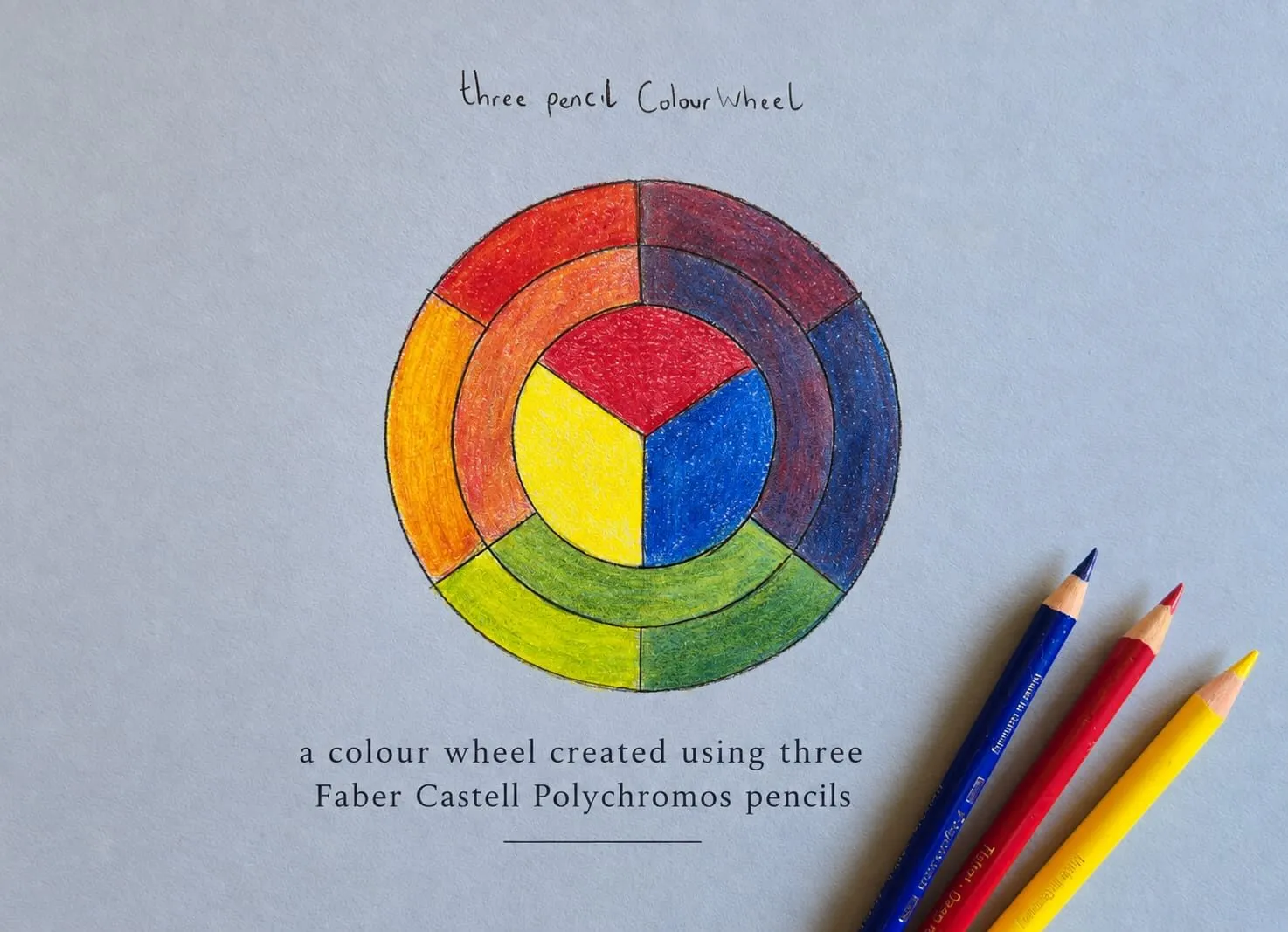
A hand-drawn colour wheel made with three Faber-Castell Polychromos pencils on blue-grey paper. Drawing by Michael Brace.
Side-by-side table
| Feature | Prismacolor Premier | Faber-Castell Polychromos |
|---|---|---|
| Base | Soft, wax-based | Oil-based, firm |
| Feel on paper | Creamy, buttery | Crisp, controlled |
| Laydown | Rich colour quickly | Builds more gradually |
| Blending | Very easy | Good with layering, less “melty” |
| Layering | Fast to build, can fill the tooth sooner | Many clean layers |
| Wax bloom | Can appear with heavy layering | Not an issue in the way it is with wax |
| Detail and points | Softer point wears faster | Holds a sharp point |
| Breakage | Softer core breaks more easily | Firmer, generally sturdier |
| Colour range | Check the current range | 120 colours |
| Price level | Check current listings | Check current listings |
| Lightfastness | Check the maker’s chart | Excellent overall, a few colours vary slightly |
Wax-based soft versus oil-based firm
Everything else follows from the binder. A wax-based pencil such as Prismacolor Premier has a soft, creamy core that deposits a lot of pigment with little pressure. An oil-based pencil such as Polychromos has a firmer core that releases pigment more steadily and keeps its shape.
We go deeper on the science and the trade-offs in wax versus oil-based coloured pencils. The short version: soft means smooth and fast, firm means precise and durable, and neither is a shortcut to good drawing.
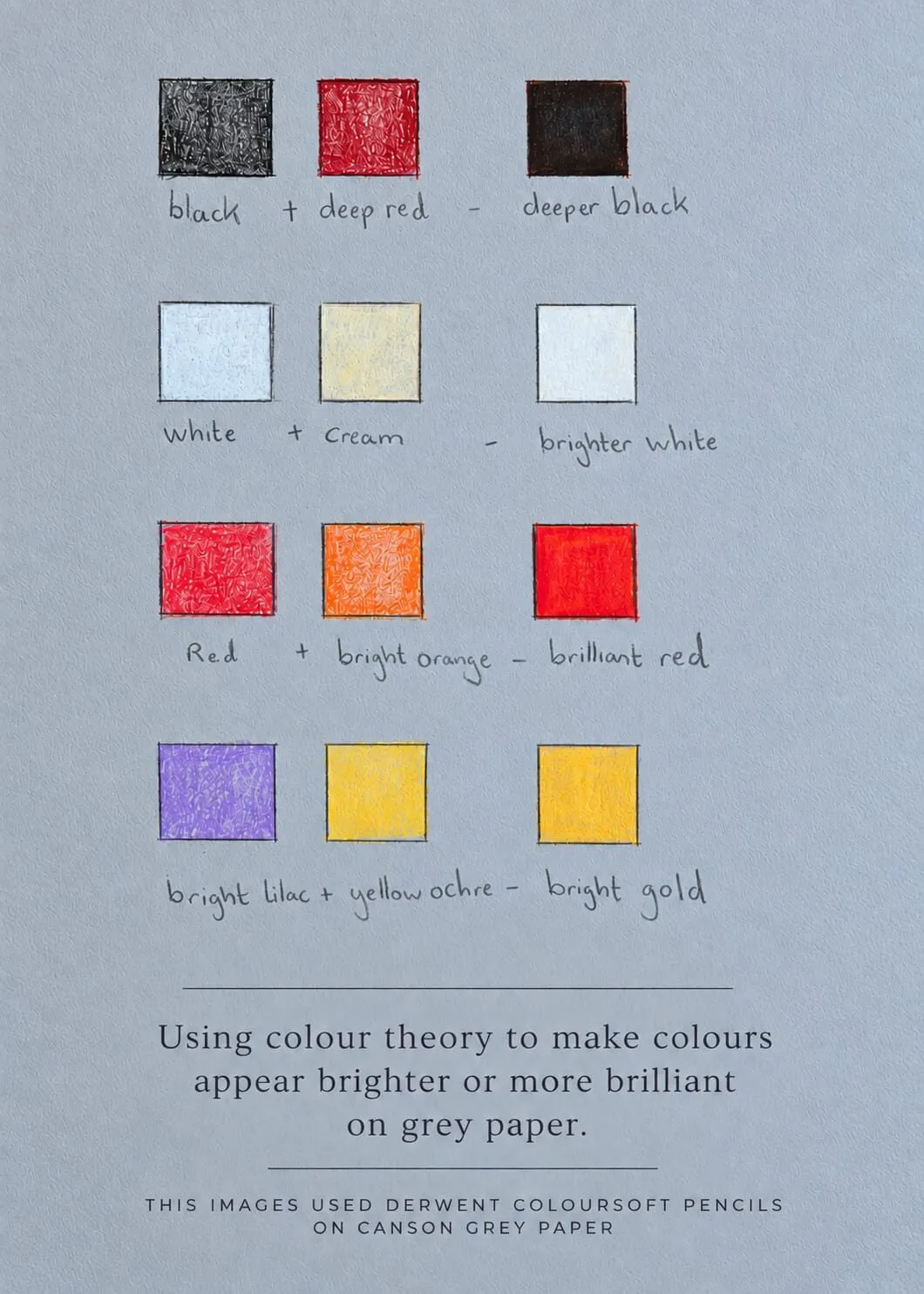
A hand-drawn swatch card on grey paper showing colour pairings: black with deep red, white with cream, red with bright orange, and bright lilac with yellow ochre. Drawing by Michael Brace.
Laydown and colour richness
Prismacolor is loved for how quickly it puts down saturated colour. A light stroke already looks rich, and a second pass fills the paper. That makes it satisfying for bold shapes, smooth gradients and quick colour blocking.
Polychromos deposit colour more gradually. You build intensity through layers rather than getting it all at once, which gives you fine control over value. Michael describes Polychromos as precise, with clean layering and consistent behaviour across the range.
Layering and blending
Prismacolor blends effortlessly. Colours melt together and the tooth of the paper fills quickly, so you can get a smooth, painterly surface with relatively few layers. The trade-off is that a heavily worked area can stop taking more pigment, and heavy layering is where wax bloom can appear.
Polychromos are firm enough that they do not clog the tooth quickly. That allows a large number of clean layers, and blending is a matter of building thin, overlapping strokes rather than melting them. If you like a soft, smoothed finish, you can still achieve it, but it takes more deliberate layering. Our guides on how to layer coloured pencils and how to blend coloured pencils cover both approaches.
Wax bloom and how to handle it
Wax bloom is the hazy, whitish film that can form on a drawing when wax-based pencils are layered heavily. It is a known quirk of soft wax pencils, not a sign of a bad drawing, and it can usually be wiped away gently with a soft cloth or tissue. It is one reason some artists switch to oil-based pencils for very layered work.
Detail, sharpening and breakage
Fine detail needs a point that lasts. Polychromos hold a sharp point for longer, which is why they are so popular for eyes, hair, feathers, fur and crisp edges. A soft Prismacolor point dulls faster, so you sharpen more often for the same detail.
Breakage is the most common complaint about soft wax pencils. A soft core is more likely to snap inside the wood or crumble when sharpened, particularly with a dull blade. Firmer pencils are generally more forgiving. Whichever you buy, a sharp, well-made sharpener matters; see best pencil sharpeners for coloured pencils and how to sharpen coloured pencils.
Lightfastness
Lightfastness is how well a colour resists fading in light. For serious work, especially anything you plan to sell or exhibit, ratings matter. Polychromos are excellent overall, though a few colours vary slightly. For Prismacolor, and for every maker, we recommend checking the manufacturer’s published lightfastness chart for the specific colours in your set rather than assuming an entire range performs the same. Our guide to coloured pencil lightfastness explains how to read those ratings.
Colour range and price level
Polychromos has a wide range of 120 colours, which suits artists who want variety and precise colour matching. For Prismacolor, ranges and set contents change, so check the current range with the maker or retailer.
On price, we do not quote figures because they vary by country, retailer and set size. Compare like with like: the same number of pencils, from the same seller, on the same day. Consider cost per drawing rather than cost per set; a pencil that stays sharp and rarely breaks wastes less.
Which is best for which subject?
| Subject | Better fit | Why |
|---|---|---|
| Portraits and skin | Prismacolor for smooth blends; Polychromos for eyes and hair | Soft transitions versus fine detail |
| Wildlife and fur | Polychromos | Sharp points for fine hair and feathers |
| Still life and metal | Polychromos | Crisp edges and clean layering |
| Food and glossy surfaces | Either | Soft blends for icing, firm for crisp highlights |
| Bold, quick colour | Prismacolor | Rich laydown with little pressure |
| Very layered realism | Polychromos | Many layers without clogging |
Our shortlist of best coloured pencils and the Polychromos review go into more depth on individual sets.
Can you use both?
Yes, and many artists do: wax for softness, oil for precision. A common approach is to block in and blend broad areas with a soft pencil, then use firm pencils for edges and detail. Just be aware that layering different binders can behave unpredictably, so test on a scrap of your chosen paper first. If you are also choosing paper, the best paper for coloured pencils matters as much as the pencil, because tooth decides how many layers you can build.
Recommendation by budget and experience
- Lower budget, learning to blend: a smaller soft set is the easiest way to experience creamy laydown. Polychromos in a small set is also worth considering if you know you want detail.
- Medium budget: decide by subject. Detail and wildlife point to Polychromos; smooth portraits and bold colour point to Prismacolor.
- Higher budget or serious realism: Polychromos is a common professional choice, and you can add softer pencils for specific jobs. See professional versus student pencils for what the upgrade actually buys.
Set sizes and contents change, so check the current range before you decide.
The short version
Prismacolor Premier is the softer, creamier, faster-blending choice, with a more delicate core and a risk of wax bloom in heavy layering. Polychromos are the firmer, oil-based choice for sharp detail and clean, deep layering. Pick by subject and by how you like to work, check each maker’s lightfastness chart, and try the pencil set quiz if you are still torn.
Where to buy
Recommended products
Affiliate links. We may earn a small commission if you buy, at no extra cost to you. Why?
Pencils · Faber-Castell
Faber-Castell Polychromos
Firm, oil-based artist pencils that hold a point - a benchmark for detail and clean layering.
Pencils · Prismacolor
Prismacolor Premier
Creamy, smooth pencils famous for easy blending and soft shading.
Quick answers
Frequently asked questions
Is Prismacolor or Polychromos better?+
Neither is better overall. Prismacolor Premier is softer and creamier, so it blends easily and lays down colour fast. Polychromos are firmer and oil-based, so they hold a point and layer cleanly for detail. Pick by the way you like to draw and what you draw most often.
Are colored pencils and coloured pencils the same thing?+
Yes. Coloured is the UK spelling and colored is the US spelling of the same product. Prismacolor and Polychromos are both sold under either spelling, and searches for colored pencils and coloured pencils lead to the same brands and the same kinds of set.
Do Prismacolor pencils break more easily than Polychromos?+
Prismacolor Premier is known for a soft core that can break more easily, especially when dropped or sharpened with a blunt blade. Polychromos have a firmer core that generally copes better with sharpening. A sharp, quality sharpener helps with either, but soft pencils always need more care.
What is wax bloom and does it affect Polychromos?+
Wax bloom is a hazy, whitish film that can rise to the surface when wax-based pencils are layered heavily. It is associated with wax-based pencils such as Prismacolor. Oil-based Polychromos layer cleanly without bloom, which is one reason artists choose them for many-layered realism.