Paper & Surfaces
Paper Tooth: Smooth vs Textured Paper for Pencil Drawing
Tooth decides how pencil grips, layers, blends and lifts. Compare smooth and textured papers, from Canson to Arches, and match the surface to your subject.
This guide contains affiliate links. If you buy through them we may earn a small commission at no cost to you. How this works.
Jump to recommended products
Key takeaways
- ◆Tooth is the texture of the paper: the tiny hills and valleys that catch pigment.
- ◆Strong tooth grips pigment, takes many layers and lifts easily, but shows texture in the finish. Minimal tooth blends smoothly but fills up faster.
- ◆Canson Mixed Media has heavy tooth, Stonehenge soft tooth, Clairefontaine fine tooth and Arches Hot Press minimal tooth.
- ◆Match the surface to the subject: texture for metal, glaze and bold contrast, smoothness for portraits, botanical work and fine detail.
- ◆You can test tooth in a minute with a swatch of layers, a light and a heavy pass, and a test erase.
Two artists use the same pencils, the same subject and the same technique, and one gets a velvety blend while the other gets a crisp, grainy finish. The difference is very often the paper’s tooth. It is the least visible part of a paper’s specification and one of the most important, because it controls how pigment sticks, how many layers fit, and how the finished surface looks.
This guide defines tooth, explains its effect on layering, blending, detail, lifting and burnishing, compares four popular papers, and gives you a quick way to test any sheet before committing a drawing to it. Tooth matters for coloured pencils (colored pencils in the US) and graphite alike. Once the paper is chosen, best blending tools for coloured pencil shows how to work the surface, and best drawing paper for beginners is a good starting point.
What tooth means
Tooth is the texture of the paper: the tiny hills and valleys that catch pigment. When you draw, the pencil point skates over the tops of the hills and deposits pigment on them first. Pressure pushes pigment into the valleys. Once the valleys fill up, the surface can hold no more, and new layers slide over the top.
That simple mechanism explains most of what follows:
- A high-tooth paper has deep valleys, so it holds a lot of pigment and takes many layers, but light pressure leaves tiny flecks of paper showing.
- A low-tooth paper has shallow valleys, so pigment goes on smoothly and the paper looks solid sooner, but it fills quickly and limits the number of layers.
Tooth is not the same as weight. A heavy paper can be smooth and a light one can be toothy. If you are unsure about the difference, see paper weight explained.
A collection of white and brown paper rolls.
How tooth changes the way you draw
Layering
Layering is the backbone of coloured pencil realism, and tooth sets its ceiling. Heavy tooth gives you room to build colour slowly, layer over layer, without the surface sealing. Smooth paper allows controlled layering too, but you need gentle pressure and you reach the limit sooner. If your style involves many layers, choose more tooth. If you build a subject in a few careful passes, you can go smoother.
Blending
Smooth papers blend most easily because there are no valleys to leave gaps between strokes. Pigment sits evenly, and transitions between tones can be very subtle. On textured paper, the grain remains visible however carefully you blend, which can be a virtue: it adds life to metal, fabric and stone. If you want to know more about the technique itself, see how to blend coloured pencils.
Detail
Fine detail such as eyelashes, botanical veins and hair strands is easiest on smooth paper, where a sharp point can travel without catching on the grain. Strong tooth breaks up very fine lines slightly. That is not always a problem: soft texture suits a lot of realism, and a sharp point on fine tooth still gives crisp marks.
Lifting and erasing
Pigment sitting on the tops of the hills lifts more easily than pigment pressed into deep valleys or sunk into a very smooth, soft surface. Papers with strong tooth are generally good for lifting highlights and corrections. On a very smooth surface, colour can be harder to lift because pigment sinks in, so planning matters more. Read lifting and erasing coloured pencil for specific methods.
Burnishing
Burnishing is pressing hard to create a smooth, glossy finish. It works by flattening the tooth and filling the valleys. On heavy tooth this transformation is dramatic and permanent: the tooth flattens quickly, which is why burnishing on a toothy paper gives such a bold change. On smooth papers a soft burnish is enough. Our guide to how to burnish coloured pencils explains when to start.
Four papers compared
Michael’s paper guides describe the tooth of four papers coloured pencil artists commonly reach for:
| Paper | Tooth | Feel and finish | Suits |
|---|---|---|---|
| Canson Mixed Media (grey) | Heavy | Most textured; grabs pigment firmly | Metal, glaze, icing, strong highlights |
| Stonehenge (white) | Soft | Velvety, softly textured | Skin, fur, feathers, realism |
| Clairefontaine Paint’On Gris | Fine | Smooth with a slight drag, painterly | Moody still life, expressive portraits |
| Arches Hot Press | Minimal | Smoothest, almost creamy | Portraits, botanical work, fine detail |
Canson Mixed Media grey is the bold one. Its heavy tooth grabs pigment aggressively, so you can draw over and over without losing grip, and it lifts well for highlights on reflective subjects.
Stonehenge has a soft tooth that grips gently. Colour sinks in to give a velvety, painterly layering that suits realism, and highlights lift with little damage to the fibres.
Clairefontaine Paint’On Gris has a fine tooth: enough grip for layering, smooth enough for painterly effects, with a subtle drag under the pencil.
Arches Hot Press has minimal tooth. It allows very smooth blending and subtle transitions, but you need more layers to achieve deep colour and gentle pressure to keep the tooth open. Pigment sinks into the smooth surface, so lifting is harder.
For a full side by side comparison, see Canson vs Arches vs Stonehenge vs Clairefontaine.
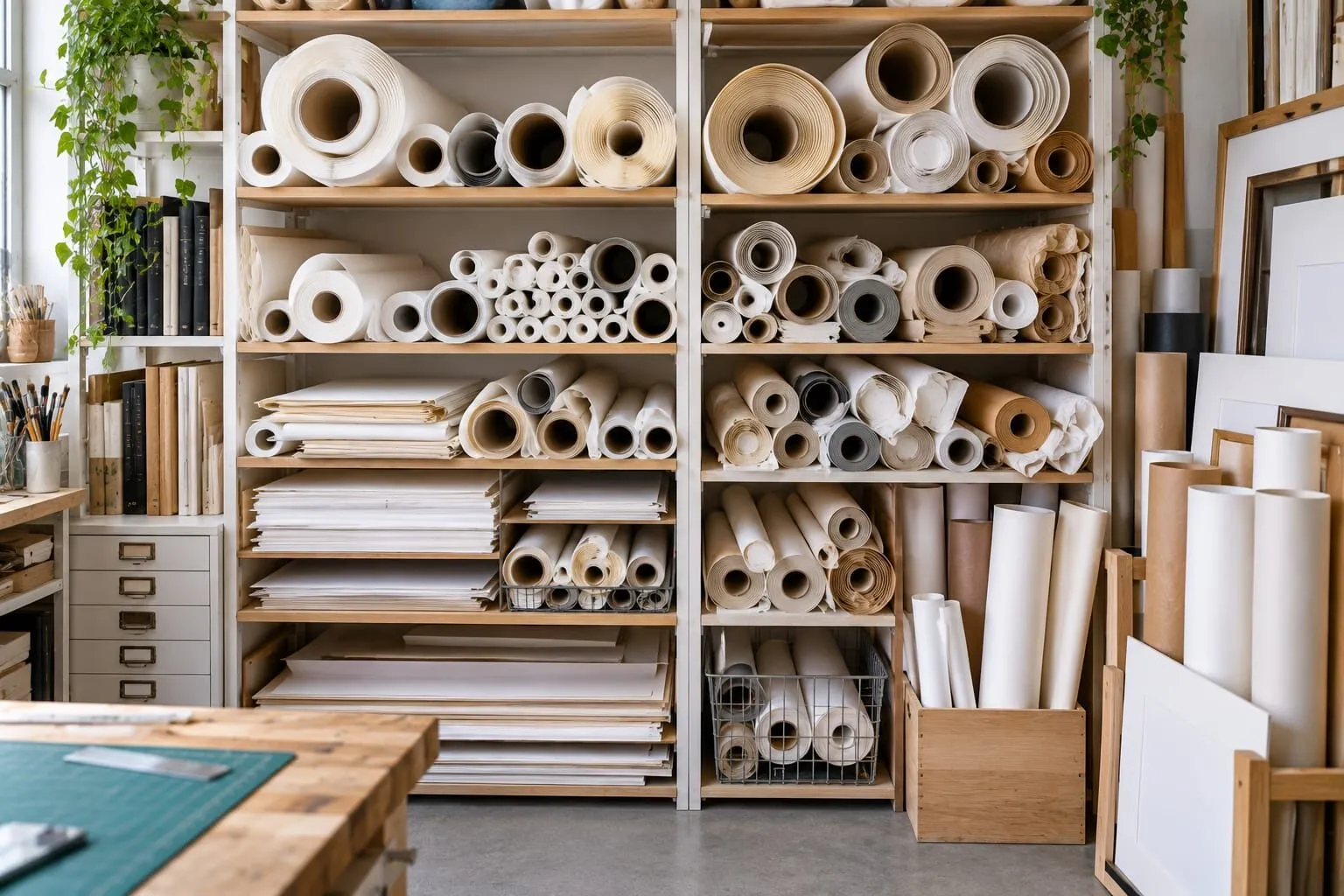
A studio storeroom with shelves of paper rolls and sheets.
Matching tooth to the subject
Use the subject to make the choice.
- Metal, glass, glaze and icing. Pick more tooth. Multiple layers and crisp highlights are the priority, and the grain reads as surface sparkle.
- Skin, portraits and delicate transitions. Pick smoother paper. Smooth paper lets tones melt together and keeps fine features clean.
- Fur, feathers and soft realism. A soft tooth such as Stonehenge gives depth without a scratchy look.
- Botanical work and fine line detail. Choose a smooth paper such as hot press.
- Atmospheric or expressive work. Fine tooth with a little drag, such as Clairefontaine, adds a painterly finish.
If you are choosing for a particular subject, the guide to the best paper for realistic drawing goes further.
How to test the tooth of a paper
You can learn a paper’s character in a few minutes with a small swatch. Use the same pencils you plan to draw with.
- Light pass. Lay one colour with very light pressure. Notice how much paper shows through. High tooth shows flecks; low tooth looks solid.
- Heavy pass. Press hard beside it. See how quickly the surface fills and whether the pigment looks waxy.
- Layer test. Lay three or four light layers of different colours over each other. Count how many the paper accepts before it slides.
- Blend test. Blend two colours with a lighter pencil or a paper stump. Look for visible grain.
- Erase test. Erase half the swatch with a soft eraser and note how much colour lifts and whether the surface is damaged.
- Detail test. Draw a few fine lines and a small circle with a sharp point.
Keep the swatch with the pencil names written beside it. It becomes a reference you can return to.
Tooth changes over the life of a drawing
The surface you start with is not the surface you finish on. Every layer fills a little more of the valleys, and every burnished area flattens them further. That is why experienced artists plan where they need tooth to survive: keep pressure light in areas that will take many more layers, and save firm pressure for the last passes. It also explains why a single paper can feel very different at the start and end of the same drawing.
Tooth and other media
Graphite reacts to tooth as well. More tooth holds more graphite for rich shadow and suits cross-hatching, while smooth paper gives finer lines and cleaner detail. See the best paper for graphite drawing for specifics, and hot press vs cold press paper for how watercolour paper surfaces map onto tooth.
The short version
Tooth is the grip of the paper. Choose heavy tooth for many layers, glossy highlights and easy lifting; choose minimal tooth for smooth blending and fine detail; and choose something in between, like Stonehenge or Clairefontaine, when you want a soft, painterly finish. Test before you commit, and keep burnishing for the end. For the wider picture, return to the paper hub.
Where to buy
Recommended products
Affiliate links. We may earn a small commission if you buy, at no extra cost to you. Why?
Paper · Canson
Canson Mixed Media Grey Paper
A toothy mid-tone grey paper that grips pigment and makes highlights glow.
Paper · Arches
Arches Hot Press Paper
Smooth, archival paper prized for portraits, fine detail and subtle blending.
Paper · Clairefontaine
Clairefontaine Paint On Gris
A darker grey paper with a painterly drag - atmospheric for dramatic lighting.
Buy on AmazonAffiliate link · opens Amazon
Quick answers
Frequently asked questions
What is paper tooth?+
Tooth is the surface texture of a paper: the tiny hills and valleys that catch and hold pigment as you draw. A paper with strong tooth grips pencil aggressively and takes many layers. A paper with little tooth feels smooth and creamy, blends easily, but has less grip for building deep colour.
Is smooth or textured paper better for coloured pencil?+
Neither is better overall. Textured paper suits layered, high-contrast subjects such as metal and glossy glaze because it grips pigment. Smooth paper suits portraits, botanical work and fine detail because it allows subtle blending. Many artists keep both and choose according to the subject.
Why does my coloured pencil stop layering?+
The tooth has filled with pigment, so there is nothing left for new layers to grip. It happens sooner on smooth paper. Use lighter pressure early on, choose a paper with more tooth for heavily built work, and avoid burnishing until the end because burnishing flattens the surface.
Does paper tooth affect graphite?+
Yes. Toothier paper holds more graphite and gives richer darks and visible texture, which suits shading and cross-hatching. Smooth paper gives finer lines and cleaner detail but reaches deep black less readily. Tooth also affects how easily graphite lifts and how much it smudges.