Coloured Pencils
Prismacolor Premier Coloured Pencils Reviewed
Prismacolor Premier coloured (colored) pencils reviewed: soft, waxy and creamy, easy to blend, with the breakage and wax bloom trade-offs, best subjects and papers.
This guide contains affiliate links. If you buy through them we may earn a small commission at no cost to you. How this works.
Jump to recommended products
Key takeaways
- ◆Prismacolor Premier is a soft, wax-based, creamy pencil that lays down rich colour quickly and blends with very little effort.
- ◆It is popular with beginners and with portrait artists because smooth shading and soft transitions come easily.
- ◆The commonly reported trade-offs are a softer core that breaks more readily and wax bloom when layers build up heavily.
- ◆It suits soft subjects such as skin, smooth icing, petals and atmospheric backgrounds better than hairline detail.
- ◆If you want firm control and many clean layers, compare it with oil-based Polychromos before you buy.
Prismacolor Premier is one of the best known names in coloured pencils, which are called colored pencils in the US. It is a soft, wax-based pencil with a creamy feel, and its reputation rests on how easily it blends and how quickly it lays down rich colour. If you want smooth shading without a struggle, it is an obvious candidate.
This review sets out what the pencil does well, where the commonly reported trade-offs bite, and which subjects and papers suit it. We keep to what is well established about soft wax pencils and to what Michael’s source notes say, so check the current range and specifications with the maker before you buy. For the wider picture, see the complete guide to coloured pencils, and if you are still choosing a set, the pencil set quiz narrows it down in a minute.
What Prismacolor Premier is
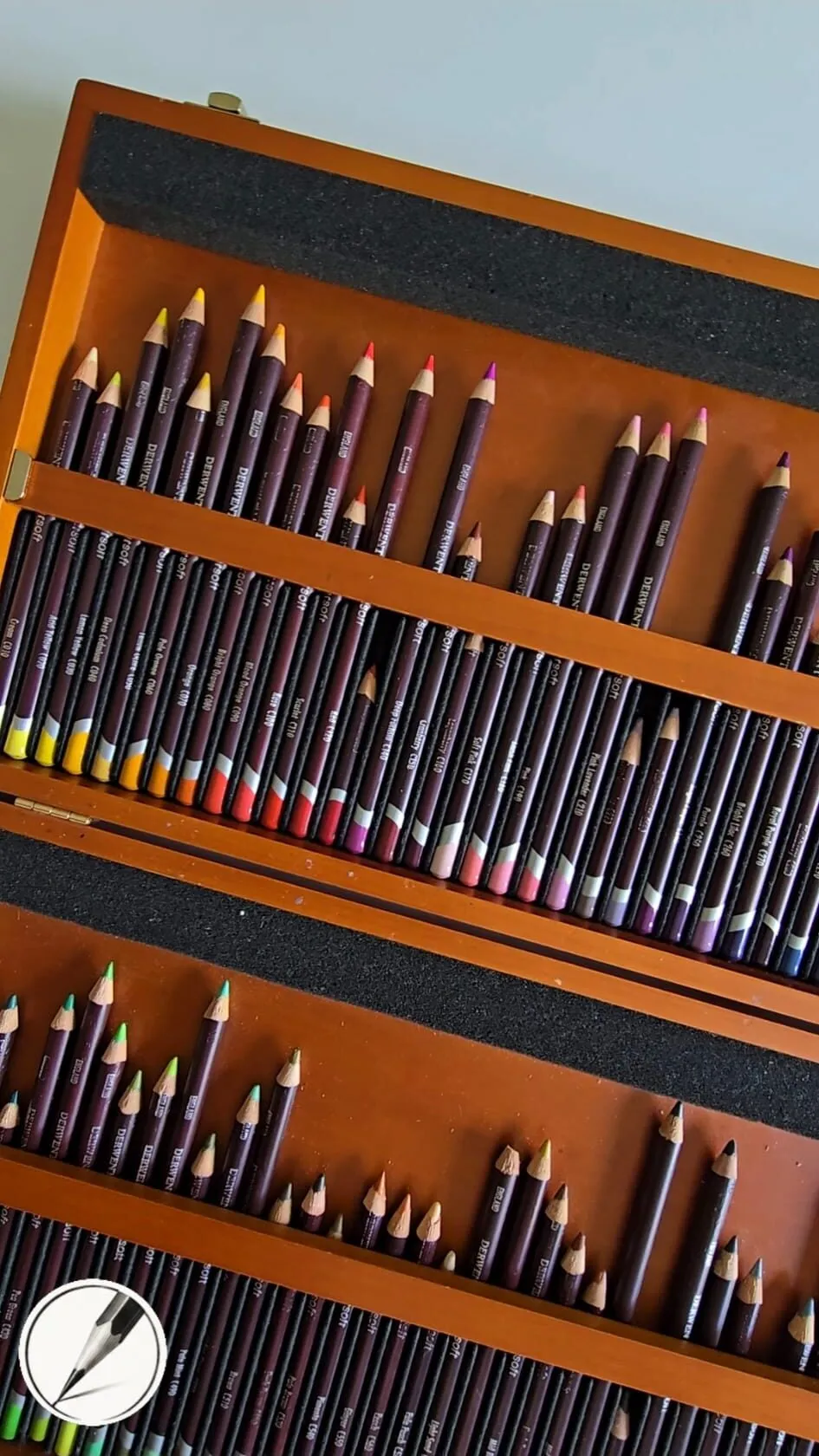
Premier is a soft, wax-based coloured pencil. The binder is wax rather than oil, and that one fact explains most of its character. Wax gives a creamy, buttery feel, lets pigment transfer to paper with very little pressure, and makes colours melt into one another when you blend.
Michael’s notes describe it in exactly those terms: creamy and smooth, great for learning blending and soft shading, and famous for its ease of use. That is why it appears beside Derwent Chromaflow and Faber-Castell Goldfaber in his beginner picks. It is not a student-grade pencil by reputation, though. Many working artists choose it for the same softness that helps beginners.
If the difference between wax and oil is new to you, wax vs oil-based coloured pencils explains what each binder does on the page.
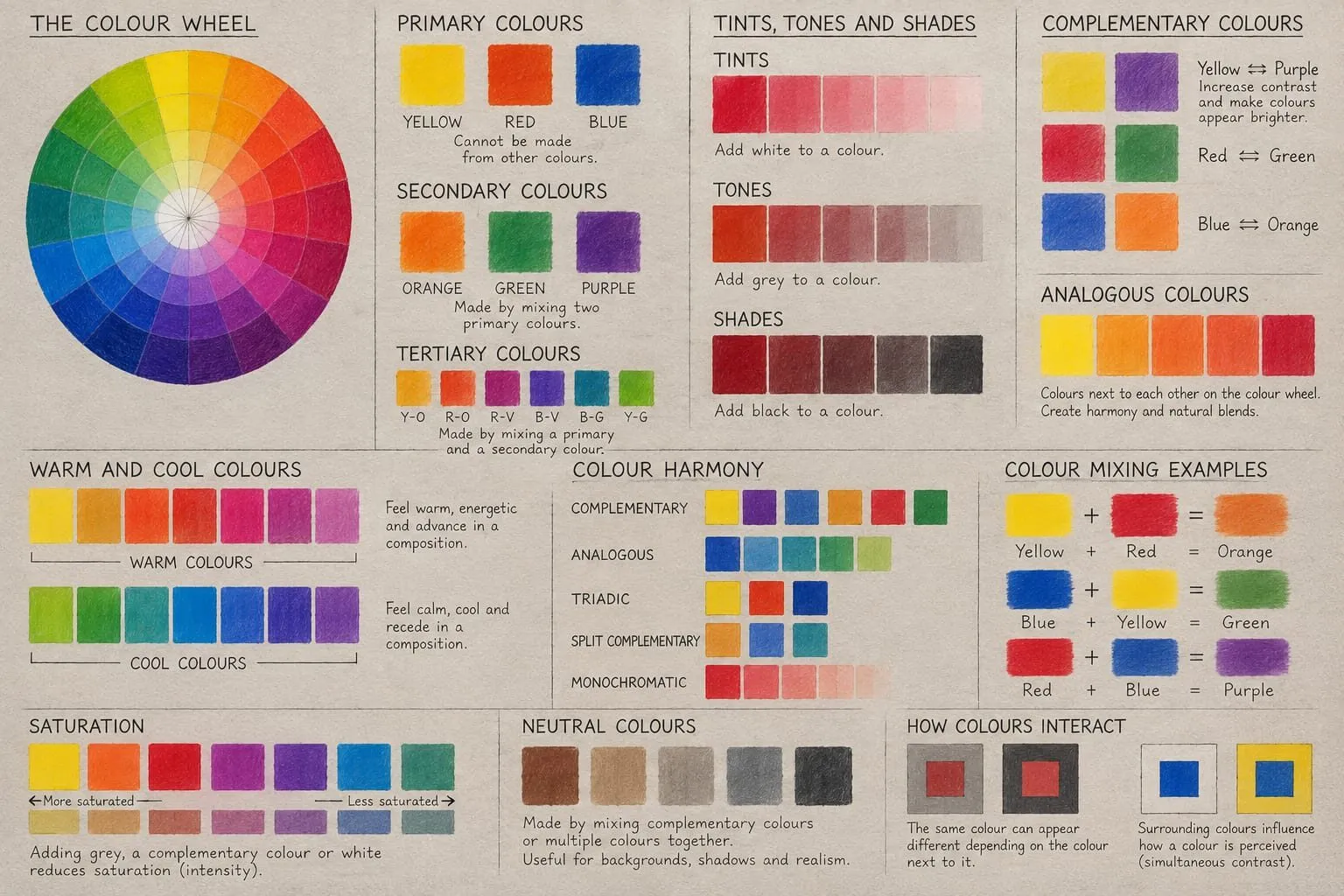
A hand-lettered colour theory chart showing the colour wheel, primary, secondary and tertiary colours, tints, tones and shades, harmony schemes and mixing examples.
How it feels and behaves
The first impression is generosity. The core glides, the colour is rich even with light pressure, and a few passes cover more paper than a firm pencil would. Large areas fill quickly, which is a real advantage on big backgrounds or smooth skin.
In practice that gives you several strengths:
- Fast coverage. Saturated colour builds quickly, so bold results arrive early, which is encouraging when you are learning.
- Easy blending. Colours mix softly where they meet, so transitions look smooth without a separate blending tool.
- Forgiving shading. Light pressure gives pale tone and heavier pressure gives depth, so pressure control is easy to see and learn.
- Burnishing. Wax melts into a unified, polished surface when you press firmly at the end. Our guide to how to burnish coloured pencils covers the method.
The trade-offs artists commonly report
Soft wax pencils all share the same two weaknesses, and Premier is regularly discussed in these terms. Treat them as widely reported tendencies rather than guarantees, since individual pencils vary.
A softer core that breaks more
Because the core is soft, it can snap when sharpened with a blunt blade, when pressed hard on a fine point, or when a pencil is dropped. Artists commonly report inner breaks that show up as repeated crumbling in the sharpener. A sharp, well-made sharpener and a light touch help a great deal. See best pencil sharpeners for coloured pencils and how to sharpen coloured pencils.
Soft pencils also dull faster, so expect to resharpen often when you want a crisp edge.
Wax bloom on heavy layering
Wax bloom is a hazy, whitish or greasy film that can rise to the surface when wax-based pencils are layered heavily. It is commonly reported with soft wax pencils. It appears most when artists press hard early and stack many layers, because the wax has nowhere to go.
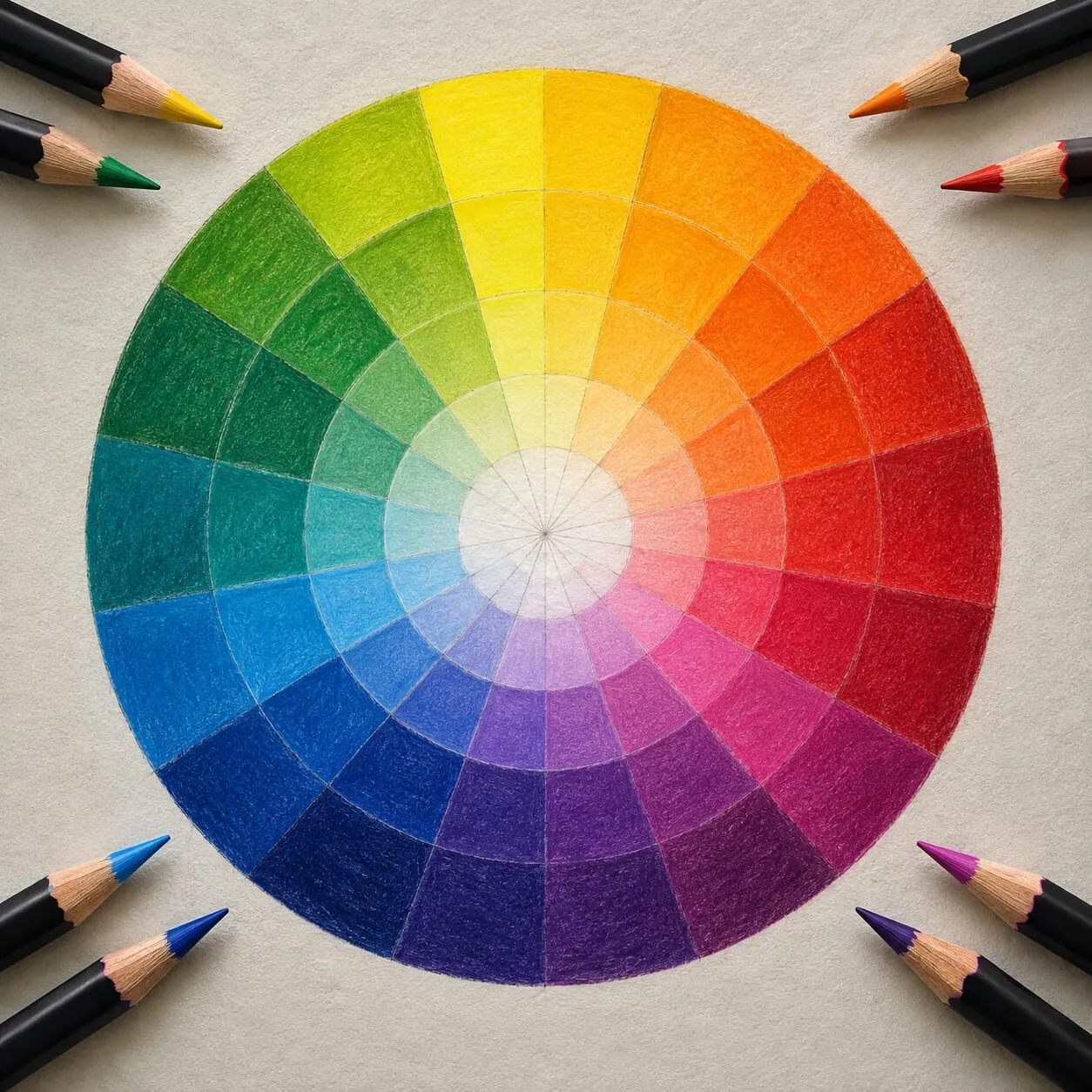
A colour wheel of radiating rings of colour surrounded by sharpened coloured pencils.
Layering and blending with soft wax
Soft wax pencils reward a particular rhythm. Start with light, even layers using the side of the point, then deepen tone in stages. Because blending is easy, it is tempting to smooth everything early. Resist that. Keep some tooth open so later layers still have somewhere to go.
For smoother results, you can blend with a light layer of a paler pencil over the top, or use a blending tool. The options are compared in best blending tools for coloured pencil, and the basic method is in how to blend coloured pencils.
Expect to work with fewer layers overall than with a firm pencil. The softness means tone builds fast, but the paper fills sooner too.
Best subjects
Premier suits work that depends on smooth, soft transition more than on crisp, hairline edges.
- Portraits and skin. Smooth gradients and gentle shading are natural here, which is why portrait artists favour soft pencils. See best coloured pencils for portraits and how to draw portraits in coloured pencil.
- Smooth, glossy or sugary surfaces. Icing, sauces and glazes need even tone and soft highlights. The wax melts into a sheen when burnished.
- Petals, sky and soft backgrounds. Wide, even areas of colour cover quickly and blend cleanly.
- Bold, saturated colour. When you want vivid results without many layers, a soft pencil delivers.
It is a weaker choice for the finest hair, whiskers and tiny crisp edges, because the point dulls quickly. Many artists solve that by using a firm pencil for the last details.
Best papers
Soft pencils lay pigment quickly, so the paper’s tooth matters because it decides how many layers you get before the surface fills.
| Paper type | What to expect with a soft wax pencil |
|---|---|
| Smooth hot press | Very smooth blends and fine transitions; fills quickly, so keep pressure low |
| Mixed media or lightly textured | More tooth to hold layers; a slightly grainier finish |
| Toned or grey paper | Rich colour stands out and highlights glow; soft pencils cover well |
For smooth portraits, our guides to Arches hot press and hot press vs cold press paper are good starting points. For a midtone base, read why use grey paper for coloured pencil, and for an overview, best paper for coloured pencils. If you are unsure, swatch on a scrap of the paper first.
How it compares
Against a firm oil-based pencil, Premier trades precision for speed and softness. The full head to head is in Prismacolor vs Polychromos: Polychromos hold a sharp point and layer cleanly, while Premier blends more easily and covers faster.
Against other soft pencils, the closest neighbour in this guide is Derwent Coloursoft, which is velvety and suited to painterly blending. See Coloursoft vs Prismacolor Premier for that comparison.
Many artists use both wax and oil: wax for soft passages and oil for precision.
Buying advice
Sets come in small, mid and large sizes, and the exact colour counts change, so check the current range before you decide. A small or mid set is enough to learn on and to see whether you like the feel. Go larger only if you find yourself short of specific hues, since a big set can tempt you to stack too many colours.
Open stock, where available, lets you replace the pencils you use fastest, such as whites and darks. Buy a good sharpener at the same time, and store the pencils carefully to avoid drops. If you plan to sell or exhibit work, check each colour’s published lightfastness information, because ratings vary between colours and ranges. Coloured pencil lightfastness explained shows how to read it.
The short version
Prismacolor Premier is a soft, creamy, wax-based pencil that blends easily, covers quickly and is loved by beginners and portrait artists alike. The commonly reported costs are a core that breaks more readily and wax bloom if you layer heavily. Keep layers light, invest in a sharp sharpener and pair it with a firm pencil for fine detail if you need one. If crisp control matters most, look at Polychromos first.
Where to buy
Recommended products
Affiliate links. We may earn a small commission if you buy, at no extra cost to you. Why?
Pencils · Prismacolor
Prismacolor Premier
Creamy, smooth pencils famous for easy blending and soft shading.
Quick answers
Frequently asked questions
Are Prismacolor Premier pencils good for beginners?+
Yes, they are a common first choice. The soft, creamy core blends easily and lays down colour with light pressure, which makes smooth shading and soft transitions approachable. Beginners should budget for a good sharpener, because the soft core can break, and should keep layers light to avoid wax bloom.
What is wax bloom on Prismacolor pencils?+
Wax bloom is a hazy, whitish or greasy film that can rise to the surface when wax-based pencils are layered heavily. It is widely reported with soft wax pencils such as Prismacolor Premier. Keeping layers light, working in thin passes and wiping the surface gently are the usual ways to manage it.
Why do Prismacolor pencils break so easily?+
Softness is the cause. A soft wax core is easier to snap when sharpened with a dull blade or when a pencil is dropped, and artists commonly report this. A sharp, quality sharpener, a gentle hand and careful storage reduce the problem, though soft pencils always need more care than firm ones.
Are colored pencils and coloured pencils the same thing?+
Yes. Coloured is the UK spelling and colored is the US spelling of the same drawing medium. Prismacolor Premier pencils are sold and discussed under both spellings, and advice about the pencils, papers and techniques applies equally whichever spelling you use when you search.