How to Draw
Drawing Ideas for Beginners: 60 Things to Draw
Stuck on what to draw? Sixty beginner-friendly drawing ideas grouped by subject, each with what it teaches and how hard it is, plus how to choose one.
Key takeaways
- ◆The best beginner idea is a simple subject you can look at directly, with one clear light source and a shape you can name.
- ◆Every idea in this list trains one specific skill, so pick by the skill you want rather than by what looks impressive.
- ◆Start with everyday objects, food and simple forms; move to faces, animals and imagination prompts once shapes and shading feel comfortable.
- ◆Repeat the same idea two or three times over several weeks - the comparison is the fastest way to see progress.
- ◆Difficulty labels are guides: a glossy object can be harder than a face if you have never drawn highlights.
Nothing stalls a drawing habit faster than the blank page and the question “what do I draw?” The answer is rarely a grand idea. It is a small, well-chosen subject that teaches you one thing you do not yet know how to do.
This list gives you 60 of them, grouped by subject. Every idea has a difficulty in plain words and a one-line note on what it teaches, so you can choose by skill instead of guessing. Pick one, set a timer, and start. If you want the choosing done for you, the 30-day drawing challenge turns the same thinking into a daily plan.
How to choose an idea
A good beginner subject has four qualities:
- You can look at it directly. Real objects and clear photos beat half-remembered scenes. Memory comes later.
- It has one clear light source. A lamp on one side gives you a light side, a shadow side and a cast shadow, which is everything shading needs.
- You can name its basic shape. If you can say “that is a sphere with a cylinder on top”, you can draw it. If you cannot, simplify.
- It is small enough to finish. A finished small drawing teaches more than an abandoned large one.
Match the idea to the skill. If your outlines wobble, choose ideas that ask for clean shapes. If your drawings look flat, choose ideas with strong light and shadow. If you keep giving up on faces, start with the parts. Each section below states the skill so you can do exactly that.
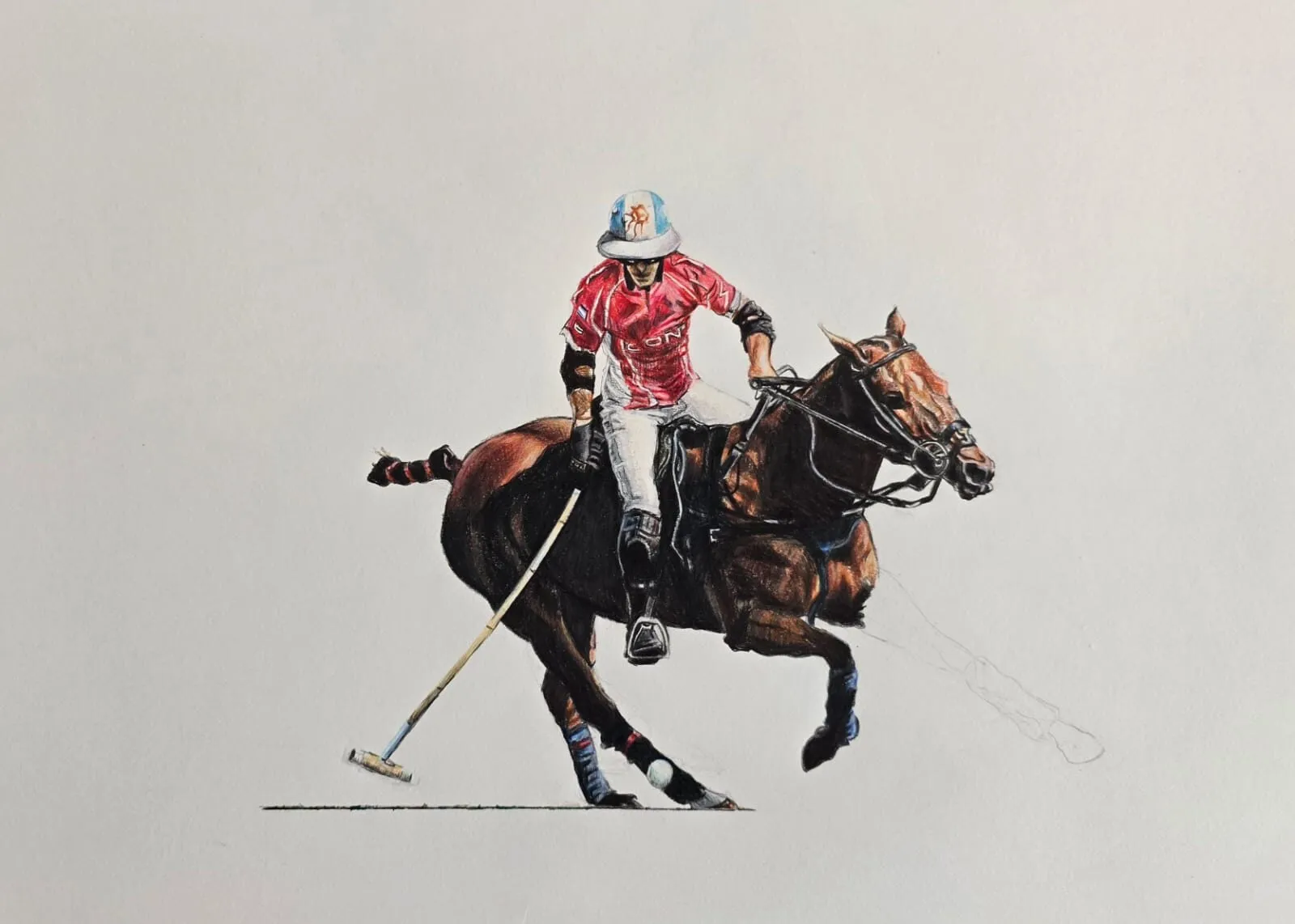
A polo player on a galloping horse drawn in coloured pencil. Drawing by Michael Brace.
How to use this list
- Pick one idea from the section that matches your current weak spot.
- Set a time limit of 15 to 45 minutes and stick to it.
- Draw it in pencil first. Graphite is the cheapest way to learn; coloured pencil - colored pencil in the US - can wait, or you can add it once the drawing is sound.
- Write the date on the back and keep it. Come back to the same idea in a month.
- When something goes wrong, look up the relevant lesson before starting again.
For paper, a plain sketchbook is enough; see drawing for beginners: where to start for a starter kit.
Everyday objects (ideas 1 to 12)
Household objects hold still, cost nothing and come with built-in light and shadow. They are the best place to learn form.
- A mug - easy. Teaches ellipses and how the rim changes shape as your eye level changes.
- A single egg - easy. Teaches smooth gradients on a curved form and a soft cast shadow.
- A drinking glass - medium. Teaches seeing through a surface, edges and small bright highlights.
- A pair of scissors - medium. Teaches overlapping shapes and simple foreshortening.
- A spoon - medium. Teaches reflections on a curved shiny surface, the first taste of highlights.
- A book standing open - easy. Teaches straight lines, angles and basic perspective; see how to draw in perspective.
- A pair of shoes - hard. Teaches foreshortening, overlapping forms and folds in materials.
- A crumpled paper bag - medium. Teaches planes of light and dark on an irregular surface.
- A key on a table - easy. Teaches small detail, sharp edges and a crisp cast shadow.
- A desk lamp - medium. Teaches combining simple shapes into a complex object.
- A ball of string or yarn - medium. Teaches following the direction of curved lines around a form.
- A wristwatch - hard. Teaches precision, small ellipses and the difference between metal and glass.
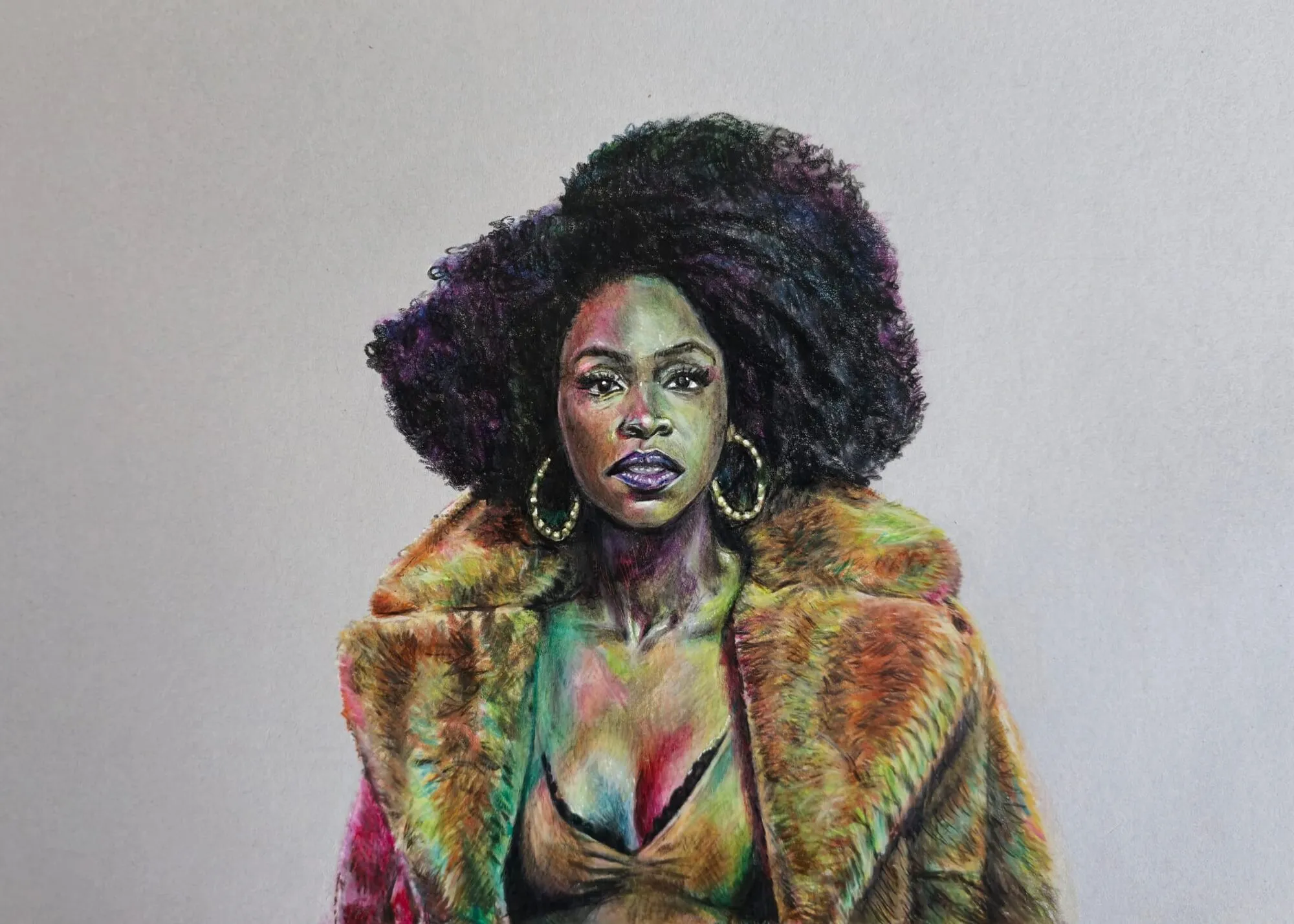
A portrait of a woman in a multicoloured fur coat drawn in coloured pencil. Drawing by Michael Brace.
Food (ideas 13 to 22)
Food is friendly, familiar and rewarding. It also introduces texture and glossiness, which is why several of Michael’s finished coloured pencil drawings are desserts.
- An apple - easy. Teaches a sphere with subtle bumps, plus reflected light in the shadow.
- A banana - easy. Teaches long curved contours and where a form turns away from the light.
- A lemon cut in half - medium. Teaches radial patterns and the difference between skin and flesh.
- A slice of bread - easy. Teaches a rough texture set against a smooth edge.
- A bunch of grapes - medium. Teaches repeating spheres, overlap and highlights that share a light direction.
- A bowl of cereal or soup - medium. Teaches ellipses and the surface of liquid.
- A cupcake with frosting - medium. Teaches soft swirls and smooth glazed surfaces.
- A glazed doughnut - medium. Teaches a torus form and a glossy highlight; the jam doughnut on grey paper is a good example of shine.
- A scoop of ice cream - medium. Teaches a rough sphere with soft highlights and melting edges.
- A whole pastry or bun - hard. Teaches layered texture, glaze and warm colour.
When you are ready to go further, how to draw food realistically walks through the method.
Nature and plants (ideas 23 to 32)
Plants are irregular but forgiving. Nobody can say a leaf is drawn wrongly, which makes them ideal for learning to observe.
- A single leaf - easy. Teaches contour, vein patterns and slight curl.
- A pinecone - medium. Teaches repeating overlapping scales and how shadow sits between them.
- A seashell - medium. Teaches spirals, ridges and smooth gradients together.
- A pebble collection - easy. Teaches distinguishing varied shapes and textures with only value.
- A sprig of rosemary or other herb - medium. Teaches small repeated shapes and simplifying detail.
- A single flower head - medium. Teaches petal overlap and value planning; try how to draw a rose once you are comfortable.
- A tree trunk - medium. Teaches bark texture and cylindrical form.
- A whole tree in winter - hard. Teaches branching structure and negative space; see how to draw a tree.
- A cloud study - medium. Teaches soft edges and gradual value changes; see how to draw clouds and skies.
- A view from your window - hard. Teaches simplifying a busy scene into big shapes and a foreground, middle ground and background.
Faces and figures (ideas 33 to 42)
Faces scare beginners because we know when they look wrong. Break them into parts and practise each one on its own.
- One eye, front on - medium. Teaches the shape of the lid, iris and highlight; see how to draw realistic eyes.
- A nose from the side - medium. Teaches soft edges and planes; see how to draw a nose.
- A pair of lips - medium. Teaches subtle shading with almost no hard outlines; see how to draw lips.
- An ear - hard. Teaches complex curves and overlapping forms.
- Your own hand, relaxed - hard. Teaches proportion and foreshortening; see how to draw hands.
- A face outline with feature guidelines - easy. Teaches proportion by placing features correctly; see how to draw a face: proportions.
- A self-portrait in a mirror - hard. Teaches sustained observation of one real face under real light.
- Hair in a simple style - medium. Teaches drawing masses of hair rather than every strand; see how to draw hair.
- A quick figure from a photo - medium. Teaches gesture, balance and simple proportions with stick-and-shape figures.
- A portrait from a photo - hard. Teaches combining every skill above; see how to draw a portrait from a photo.
Animals (ideas 43 to 50)
Animals teach texture and character. Photos are essential, since animals rarely pose.
- A pet sleeping - medium. Teaches soft simplified shapes on a subject that stays still.
- A dog’s face - hard. Teaches fur direction and eyes that carry expression; see how to draw a dog.
- A bird on a branch - medium. Teaches simple body shapes and feather groups; see how to draw a bird.
- A horse head - hard. Teaches larger proportions and smooth muscle planes; see how to draw a horse.
- A cat curled up - medium. Teaches fitting a complex shape into one simple oval.
- A fish - easy. Teaches overlapping scales and a strong side profile.
- A butterfly - medium. Teaches symmetry and pattern.
- An elephant close-up - hard. Teaches skin texture and tone in graphite; the animal drawings in graphite and charcoal show what is possible.
Patterns and exercises (ideas 51 to 56)
Not everything needs a subject. These short drills build hand control and take ten minutes.
- A page of straight lines - easy. Teaches steady, confident strokes.
- A value scale of five to nine steps - easy. Teaches controlled pressure; see how to shade with pencil.
- Hatching and cross-hatching squares - easy. Teaches building tone with line; see hatching and cross-hatching.
- A sphere, cube, cylinder and cone - medium. Teaches the four forms behind nearly every subject; see basic forms and shading.
- Contour drawing without looking down - medium. Teaches hand and eye coordination; expect it to look strange.
- A repeating pattern in a grid - easy. Teaches consistency and patience.
Imagination prompts (ideas 57 to 60)
Once you can draw what you see, try drawing what you make up. Use a photo or object to anchor the details.
- A house with a story - medium. Teaches combining perspective, texture and mood.
- Your favorite meal as a landscape - medium. Teaches designing a composition from familiar shapes.
- A still life of objects that do not belong together - medium. Teaches composition, relative size and overlap.
- The same object in three different light conditions - hard. Teaches how much lighting changes what you see; see how to draw shadows and light.
Make an idea harder or easier
You can change any subject’s difficulty without changing the subject:
- Easier: reduce the time, use only one pencil, draw it at half size, or ignore the background.
- Harder: add a second object, use a lit background, work at a larger size, or draw it in colour.
If you want to try the same ideas in color, coloured pencil ideas with paper and technique suggestions are in our list of coloured pencil drawing ideas.
Tools that make ideas easier to start
- The grid drawing tool helps you transfer a photo accurately.
- The value study tool turns a photo into greyscale so you can see the shadow shapes.
The short version
Choose a simple subject, pick the skill it teaches, keep it small and time-limited, and repeat it a few weeks later. That loop beats hunting for inspiration every time. If you want structure rather than a menu, follow the 30-day drawing challenge.
Quick answers
Frequently asked questions
What should a complete beginner draw first?+
Start with a single everyday object on a plain background, such as a mug, an egg or a piece of fruit. These have simple shapes, clear shadows and no one expects them to look like anything but themselves. Draw it from a fixed position with a lamp to one side, and spend the session on shape and shading rather than detail.
How do I come up with ideas when I have no inspiration?+
Use a limit instead of waiting for inspiration. Pick a subject from this list, set a timer for 20 minutes, and choose one skill to focus on, such as edges or shadow shapes. Constraints remove the hardest decision and let you begin. Inspiration usually arrives after you have started marking the page, not before.
Should I draw from photos or from real objects?+
Both are useful. Real objects teach you how light falls on form and let you move around them. Photos are convenient, hold still and suit animals and faces. A sensible split is real objects for basic forms and still life, and photos for subjects that will not sit for you. Use a grid or value study to keep photo work accurate.
How many drawing ideas should I try in a week?+
Two or three well-chosen ideas are better than seven rushed ones. Aim for short daily sessions of 15 to 30 minutes, with one main subject per few days. Repeating a subject shows your progress more clearly than constantly switching, and gives you a chance to fix what went wrong the first time.