Drawing Techniques
Coloured Pencil Drawing Ideas: 40 Subjects to Try
Forty coloured (colored) pencil drawing ideas, from glossy objects and desserts to animals and portraits, each with what it teaches and the paper that suits it.
This guide contains affiliate links. If you buy through them we may earn a small commission at no cost to you. How this works.
Jump to recommended products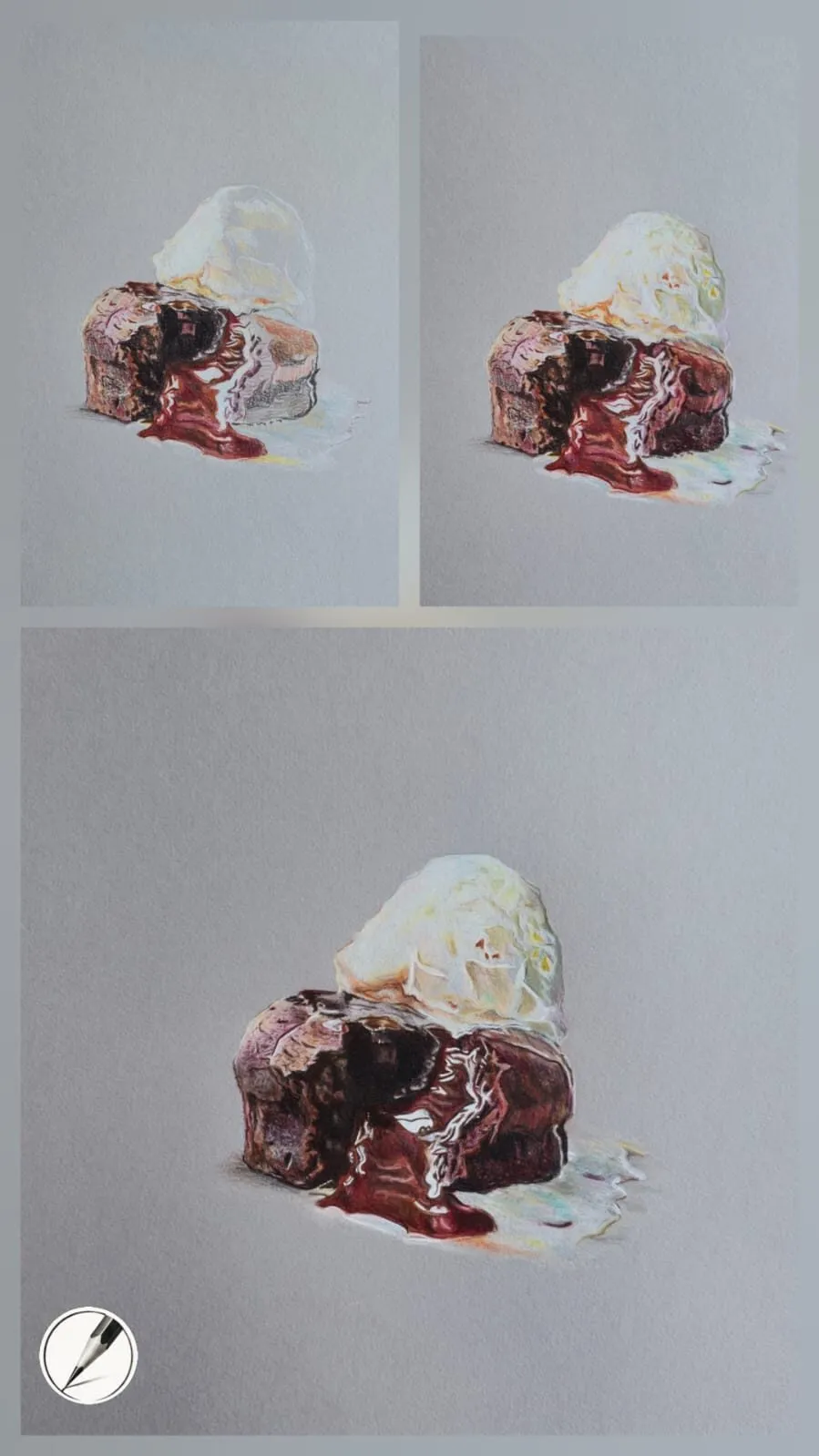
Key takeaways
- ◆Coloured pencil rewards subjects with colour, gloss and texture: desserts, metal, fruit, flowers, animals and rich portraits.
- ◆Match the subject to the paper: grey suits shiny, reflective work; smooth white or cream suits skin, fur and soft blends.
- ◆Each idea below names the skill it teaches, so you can choose by what you want to practise.
- ◆Start with a single simple object, then move to combinations, animals and portraits as layering and blending become natural.
- ◆Colour exercises are as valuable as finished pieces; a swatch or colour wheel teaches more than an unplanned scribble.
Coloured pencil - colored pencil in the US - has a look of its own: saturated, controlled and slightly luminous, built from dozens of light layers. Some subjects make the most of that. Others fight it. Choosing well is half of a good drawing.
This list gives 40 ideas that suit the medium, grouped by subject. Each one says what it teaches and which technique or paper works best. If you are new to the medium, work through coloured pencil drawing for beginners first, then come back here. For non-coloured subjects and graphite, see the wider list of drawing ideas for beginners.
How to pick a subject
Choose by what you want to learn, then by what you enjoy looking at. A subject you like will get finished.
- To learn layering: pick something with smooth, simple colour changes, such as fruit.
- To learn highlights: pick something glossy, and use grey paper.
- To learn blending: pick skin, petals or icing, on smooth paper.
- To learn texture: pick fur, feathers or bark, and work in short, directed strokes.
Whichever you choose, work from a real object or a clear photo, and use the palette from photo tool to pull out the main colours before you start.
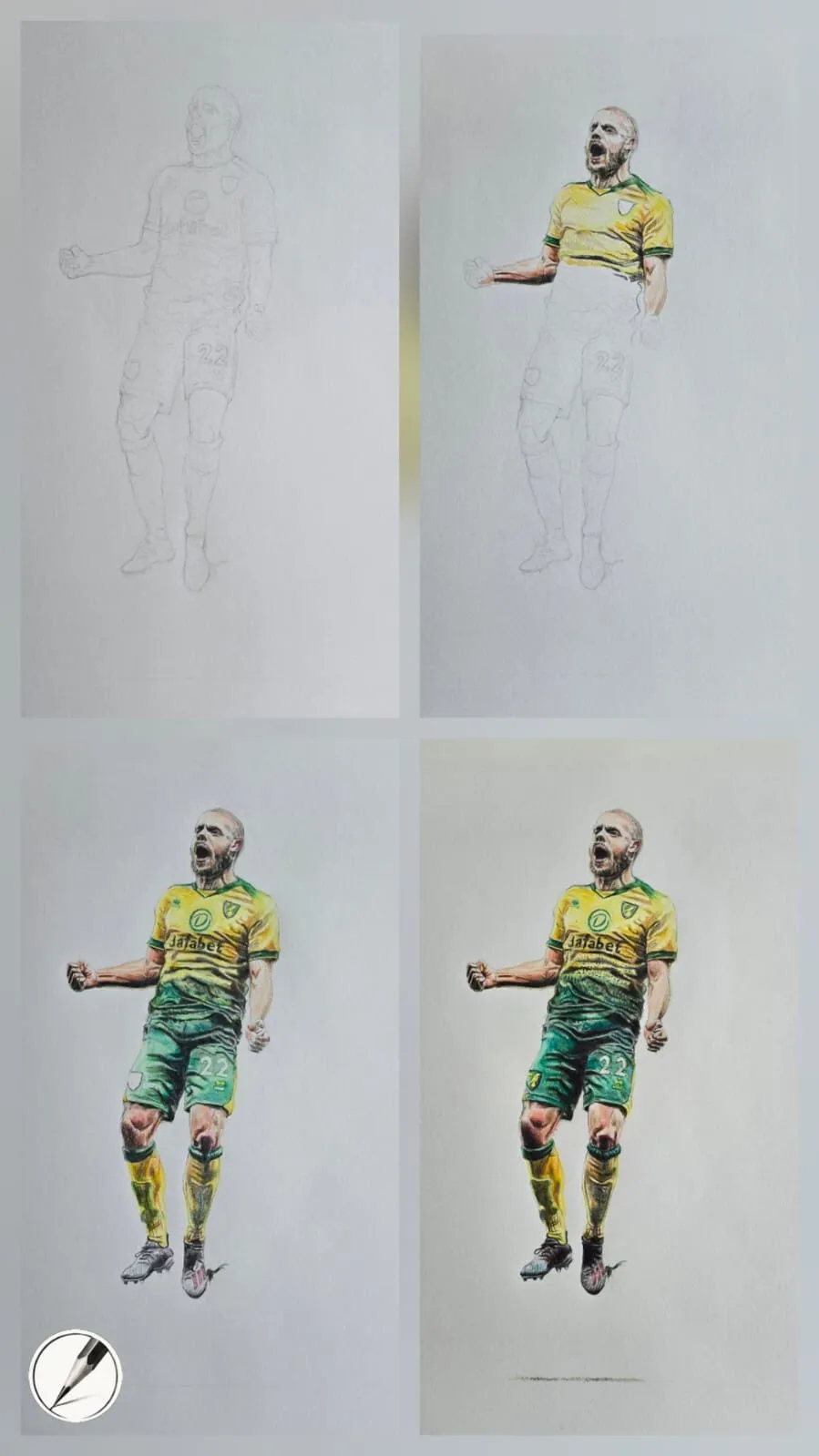
A footballer drawing shown from pencil layout to completed colour in four stages. Drawing by Michael Brace.
Glossy objects (ideas 1 to 8)
Gloss is coloured pencil’s showpiece. Smooth mid-tones and a few crisp highlights are all it takes. The full method is in how to draw glossy surfaces. Grey, toothy paper such as Canson Mixed Media suits all of these.
- A silver spoon or metal cutlery. Easy to medium. Teaches reflections and sharp contrast on a curved surface.
- Board-game tokens or coins. Medium. Teaches metal edges and repeated forms; see how to draw shiny metal and reflections.
- A glass marble. Medium. Teaches seeing light through a sphere.
- A ceramic mug with a glaze. Easy. Teaches ellipses and soft reflections.
- A trophy or cup. Hard. Teaches strong reflections and gold or silver colour.
- A polished stone. Medium. Teaches subtle gloss and colour variation.
- A shiny toy car. Medium. Teaches sharp highlights and reflected colour.
- A water droplet on a leaf. Hard. Teaches highlights, refraction and tiny cast shadows.
Food and desserts (ideas 9 to 16)
Food gives you warm colour, gloss and texture at once, and you can eat the reference afterwards. A glazed pastry, doughnut or scone is a favourite among Michael’s coloured pencil subjects.
- A glazed doughnut. Medium. Teaches sugar, glaze and shine.
- A scone with cream and jam. Medium. Teaches soft texture against a glossy topping.
- A slice of cake. Medium. Teaches layers, crumbs and cast shadow.
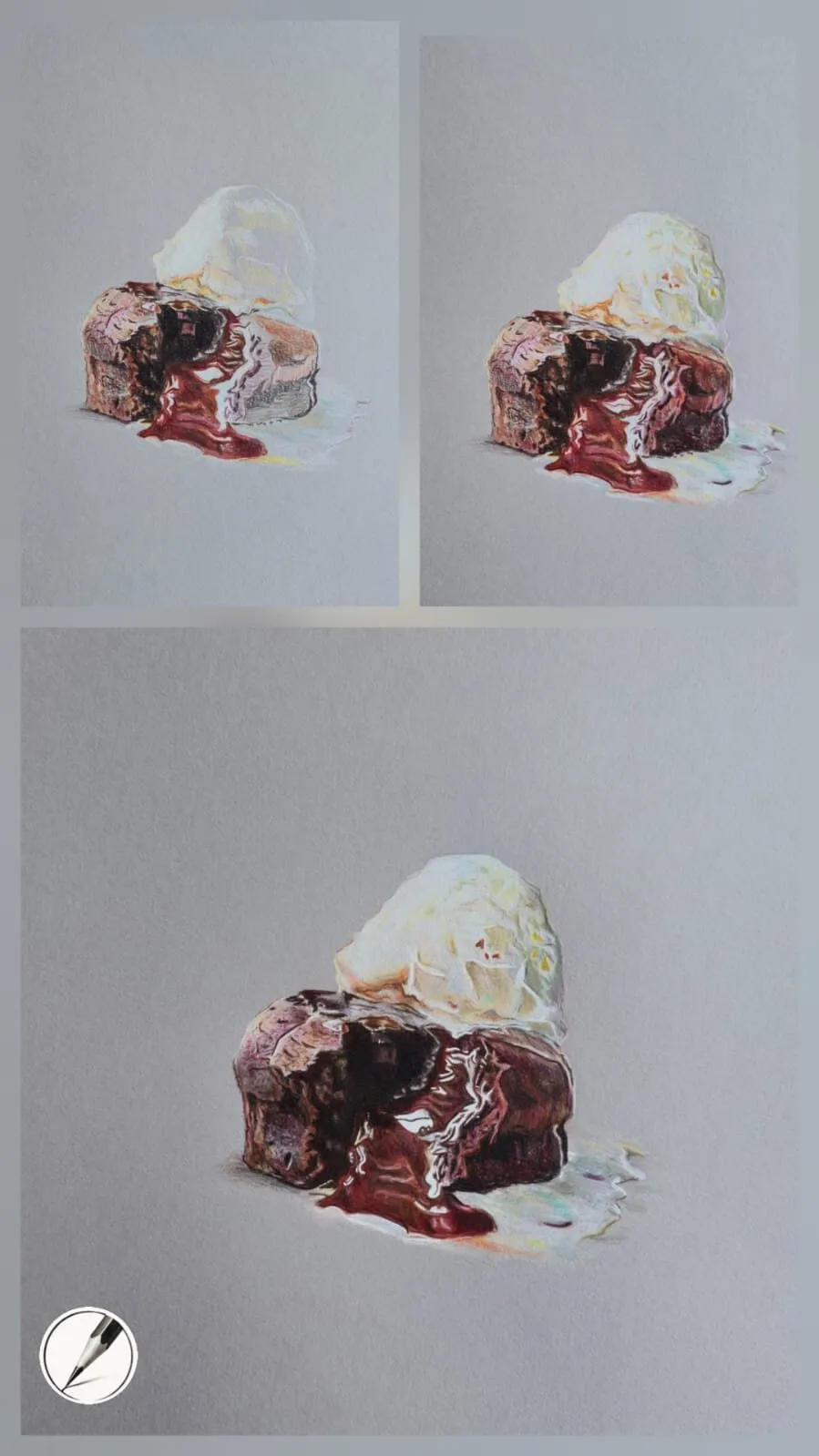
- A chocolate dessert with sauce. Hard. Teaches deep browns and wet-looking highlights.
- An iced bun with a cherry. Easy to medium. Teaches smooth icing and a single sharp accent.
- A bowl of berries. Medium. Teaches repeated forms with saturated colour.
- A cup of coffee with foam. Medium. Teaches translucent tones and soft highlights.
- A pastry with raisins. Medium. Teaches many small details set in a simple overall form.
For method, see how to draw food realistically.
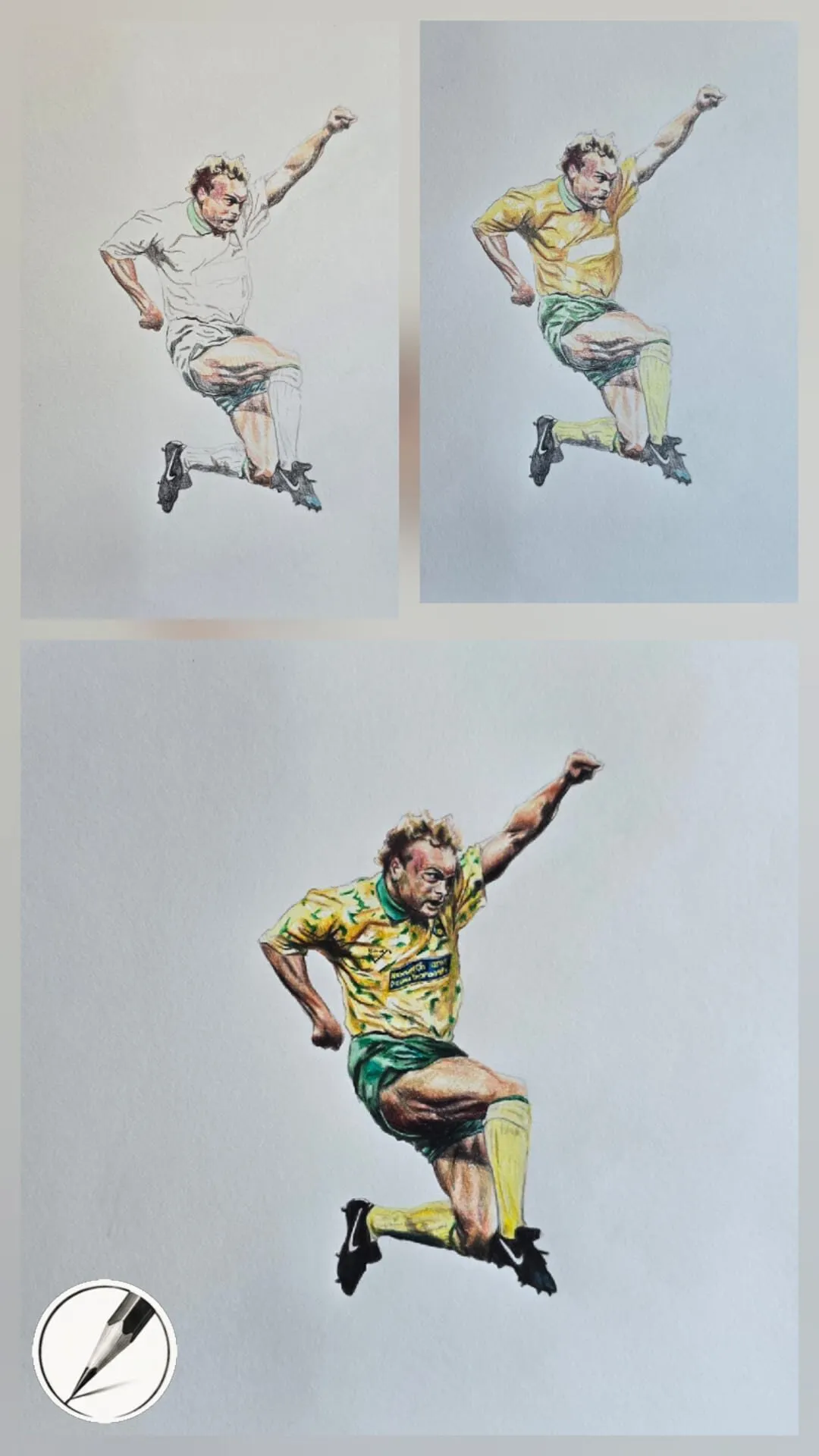
A leaping footballer drawn in coloured pencil, shown in three stages. Drawing by Michael Brace.
Fruit and flowers (ideas 17 to 24)
Nature gives you rich colour and many gentle gradients. Smooth paper helps with petals; a light grey paper helps with glossy fruit.
- A red apple. Easy. Teaches layered reds, reflected light and a soft shadow.
- An orange with peel texture. Medium. Teaches dimpled texture and warm colour mixing.
- A pear. Easy. Teaches subtle green and yellow transitions.
- A lemon half. Medium. Teaches pale, luminous colour and radial structure.
- A single rose. Hard. Teaches petal overlap and value planning; see how to draw a rose.
- A sunflower. Hard. Teaches strong yellow, texture in the centre and value contrast.
- A tulip or poppy. Medium. Teaches translucent petals and saturated colour.
- A leaf study with autumn colour. Easy. Teaches colour transitions within one shape.
Animals (ideas 25 to 30)
Animals are for those who enjoy texture. Work on smooth white or cream paper for fur, and follow the growth direction of the hair; see how to draw animal fur.
- A fluffy dog. Hard. Teaches soft fur, fine detail and expressive eyes.
- A cat’s face. Medium. Teaches fur direction and eye colour.
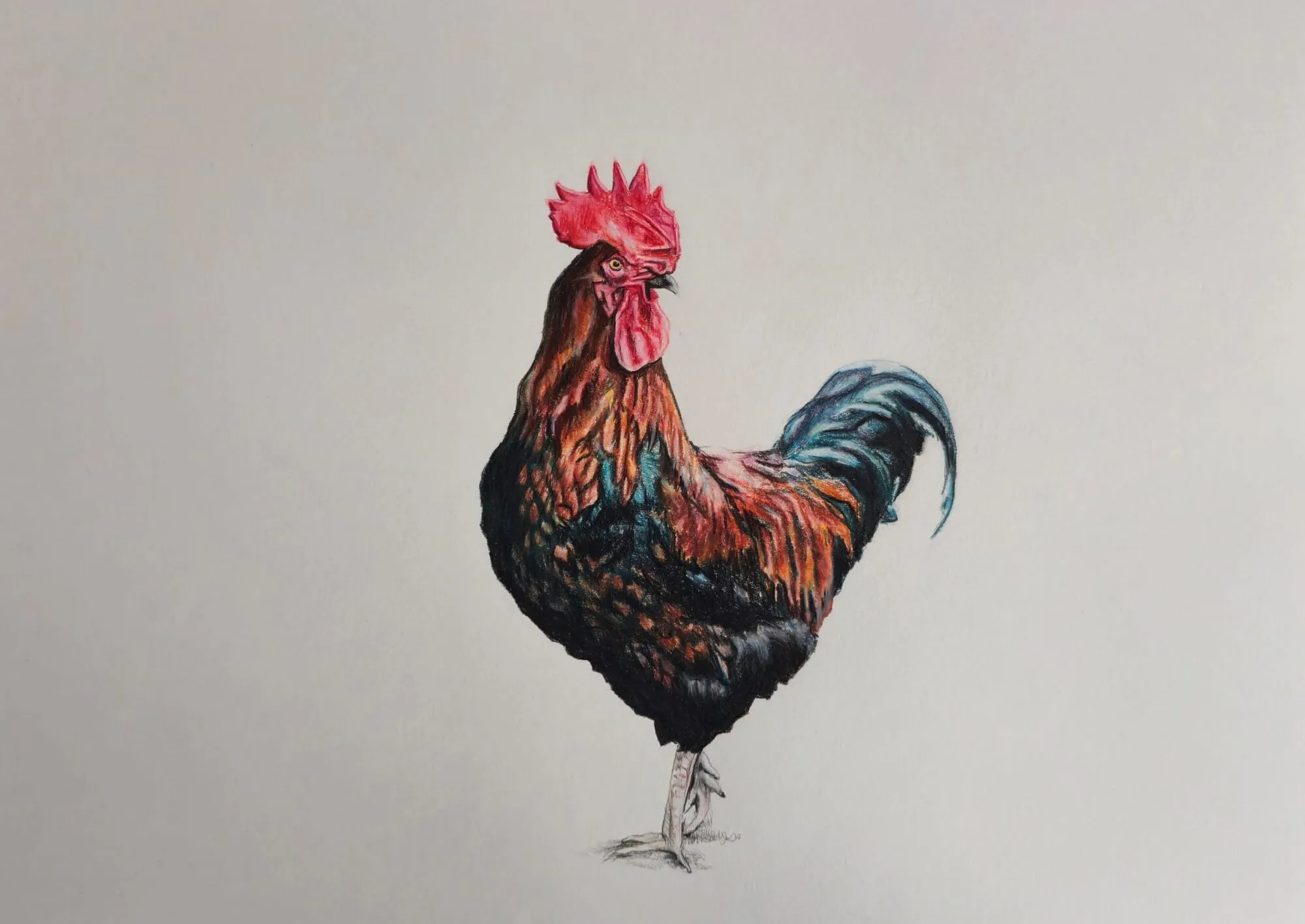
- A rooster. Medium. Teaches saturated colour and feather patterns.
- A horse head. Hard. Teaches smooth muscle planes and subtle coat colour.
- A songbird on a branch. Medium. Teaches small forms and feather detail.
- A fish with scales. Medium. Teaches iridescent colour and overlapping texture.
Portraits (ideas 31 to 34)
Portraits use every skill, especially skin tones and blending. Smooth paper and patience matter most; see how to draw portraits in coloured pencil.
- A portrait with a coloured scarf or hat. Hard. Teaches skin tones next to saturated fabric.
- An older face with character. Hard. Teaches lines, texture and subtle shifts in tone.
- A profile with a plain background. Hard. Teaches edges and simple shape.
- A self-portrait. Hard. Teaches sustained observation and the widest range of tones.
To mix natural skin colours, see how to mix skin tones with coloured pencils.
Landscapes and scenes (ideas 35 to 37)
Landscapes teach atmosphere. Keep them small at first.
- A winter field with horses. Medium. Teaches limited colour, soft distance and cool light.
- A tree line at sunset. Medium. Teaches gradients and silhouette; see how to draw clouds and skies.
- A stadium or building in snow. Hard. Teaches layout, structure and detail hierarchy.
Colour exercises (ideas 38 to 40)
Not every idea needs to be a finished picture. These build colour knowledge.
- A three-pencil colour wheel. Easy. Teaches mixing from limited pencils; see the colour wheel explained.
- A swatch card on grey paper. Easy. Teaches how colours shift and brighten on a mid-tone; see colour theory on grey paper.
- A limited-palette still life. Medium. Teaches harmony with five or six pencils; see limited palette drawing.
Matching subject, technique and paper
| Subject type | Key technique | Suggested paper |
|---|---|---|
| Glossy objects | Layered mid-tones, crisp highlights last | Grey, toothy (mixed media grey) |
| Desserts | Layering, glaze highlights | Grey or smooth white |
| Fruit | Layering and blending | Smooth white or light grey |
| Flowers | Blending, value planning | Smooth hot press |
| Animals | Directed strokes, underlayers | Smooth white or cream |
| Portraits | Fine blending, burnishing | Smooth hot press |
| Landscapes | Underpainting, gradients | Textured or mid-weight paper |
For more on the options, see the best paper for coloured pencils. To choose a set, try the pencil set quiz.
Building a series
Once you have a few finished pieces, a small series gives your practice direction. Draw three related subjects, such as a doughnut, a scone and an iced bun, on the same paper with the same pencils. Because the conditions are constant, you can see exactly what improves from one drawing to the next. A series also gives you a natural set to photograph, frame or share; see how to photograph your drawings for getting good images of the finished work.
Another option is a colour-led series: one subject in warm light, then cool light, then a limited palette. It teaches how much colour choices change mood, and it links directly to the exercises in the last section.
Tips for working through the list
- Repeat, do not just move on. A second attempt at the same subject teaches more than a new subject.
- Do the value first. A quick greyscale study shows whether the drawing will read; the value study tool helps.
- Keep layers light and read how to layer coloured pencils if colours look flat.
- Photograph each finished piece. A dated record shows progress over time.
The short version
Choose glossy objects and desserts to learn highlights, fruit and flowers to learn gradients, animals to learn texture and portraits when blending feels natural. Match the paper to the subject, keep each drawing focused on one skill and repeat the ones that teach you most.
Where to buy
Recommended products
Affiliate links. We may earn a small commission if you buy, at no extra cost to you. Why?
Paper · Canson
Canson Mixed Media Grey Paper
A toothy mid-tone grey paper that grips pigment and makes highlights glow.
Paper · Arches
Arches Hot Press Paper
Smooth, archival paper prized for portraits, fine detail and subtle blending.
Quick answers
Frequently asked questions
What should I draw with colored pencils as a beginner?+
Start with a single rounded object such as an apple, a glazed bun or a mug, on grey or white paper with a lamp to one side. These have simple shapes and clear light, so you can practise layering and blending without worrying about complex proportions. Move on to metal, fruit or flowers once you feel confident.
What subjects look best in coloured pencil?+
Subjects with rich colour, gloss and detail suit the medium: desserts, fruit, flowers, shiny metal, animals with fur or feathers, and portraits. The layered, controllable finish is good at highlights and subtle transitions. Big, loose landscapes are possible but slower, so start with a small crop of a scene.
What paper should I use for coloured pencil drawing ideas?+
Match paper to subject. Grey, toothy paper such as mixed media grey suits glossy, reflective subjects. Smooth hot press or white paper suits portraits, botanicals and fine detail. Choose a heavier sheet, since most ideas need many layers. See our paper guide for the best options at each budget.
How long does a coloured pencil drawing take?+
It varies with size, subject and how many layers you use. A small study can be finished in a session or two; a detailed piece takes many sessions spread over days or weeks. Plan for slow, patient work and short daily sessions, and do not compare your first drawings with polished professional pieces.