Colour Theory
The Colour Wheel Explained for Pencil Artists
Primary, secondary and tertiary colours, warm and cool halves, complements, and how to make a colour wheel with just three pencils. RYB versus RGB explained.
Key takeaways
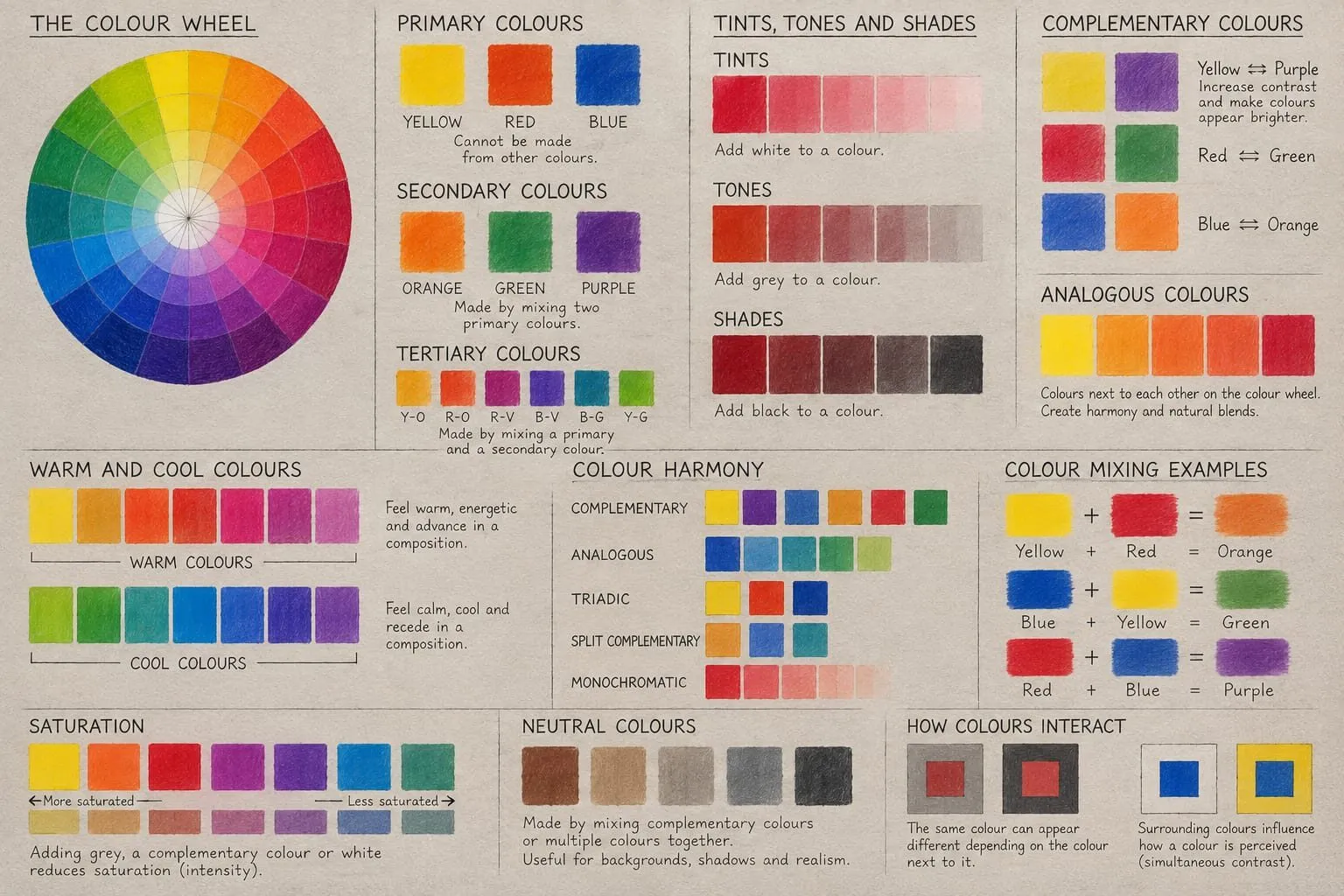
- ◆The colour wheel arranges hues in a circle so you can see which ones are neighbours, opposites and partners.
- ◆Traditional artist's wheels use red, yellow and blue as primaries; digital RGB wheels describe light and use different primaries.
- ◆Making your own wheel with three pencils shows you what those pencils can and cannot mix.
- ◆The wheel splits roughly into a warm half and a cool half, and the opposite of any colour is its complement.
- ◆Treat the wheel as a guide to relationships, not a recipe. Real pencils never match the theory exactly.
The colour wheel is the oldest and most useful diagram in colour theory, and most people meet it as a printed chart in a school classroom. For a pencil artist it works far better as something you make yourself. It shows you which colours sit together, which ones oppose each other, and how your own pencils behave when you layer them.
This guide explains how the wheel is built, why there are two versions in circulation, and how to make your own with three pencils. It is part of our colour theory for pencil artists cluster, and it is the best place to start. You can make the wheel with coloured pencils, called colored pencils in the US. Once you have one, the palette from photo tool shows where a reference sits on it, and the pencil set quiz helps you pick pencils.
What the colour wheel actually shows
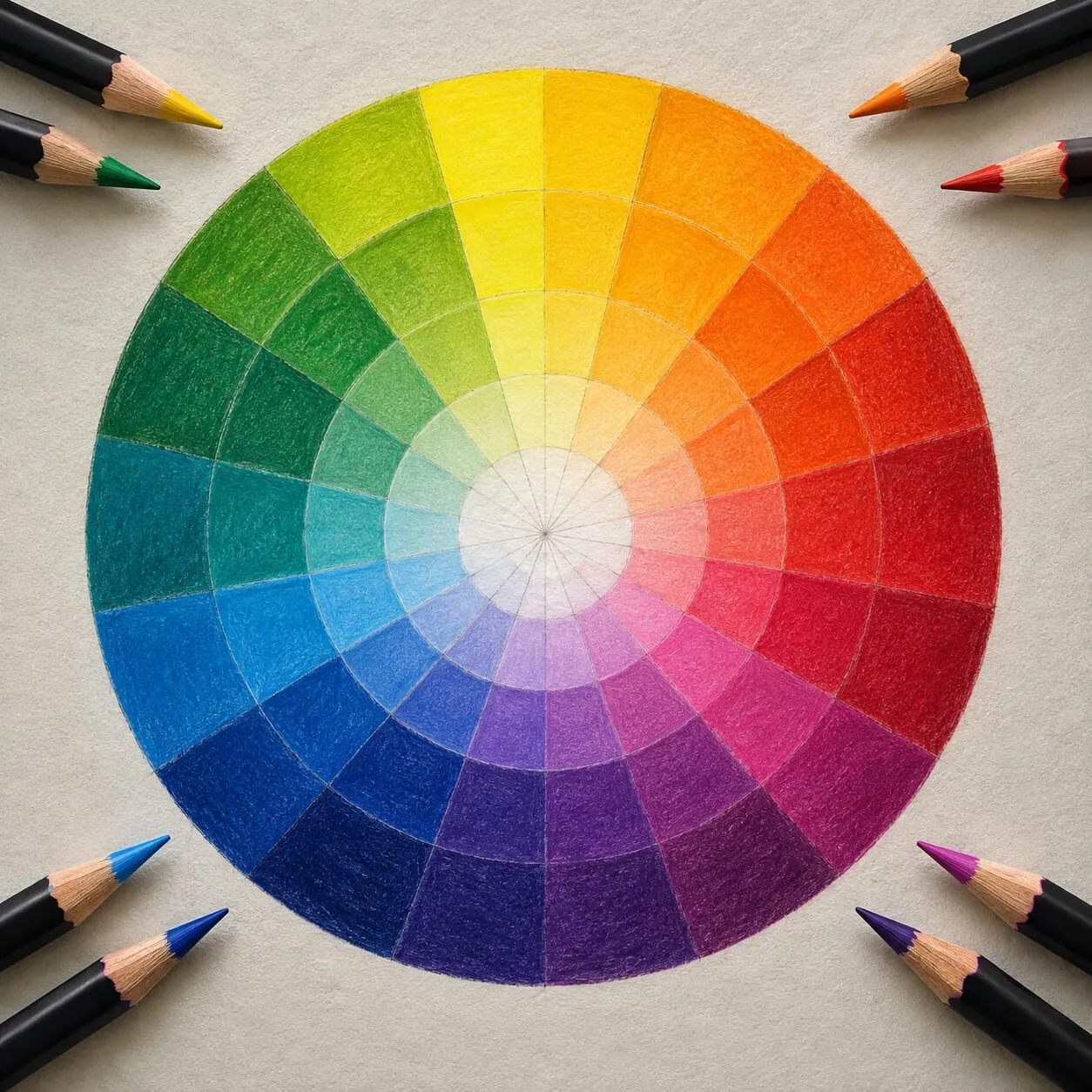
A colour wheel arranges hues around a circle so that related colours sit close together and opposite colours sit across from each other. That single layout answers three practical questions:
- Which colours will blend smoothly? The ones that sit next to each other.
- Which colours will contrast strongly? The ones directly opposite.
- Which colours will feel balanced together? Evenly spaced groups of three or four.
It is a map of relationships, not a rulebook. You can draw beautifully without ever looking at it, but when a colour choice feels wrong and you cannot say why, the wheel usually tells you.
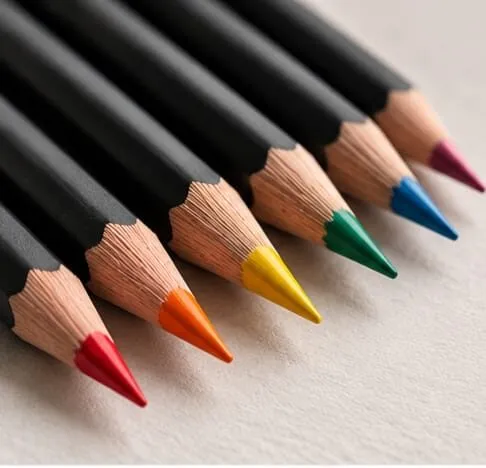
Close-up of a row of sharpened coloured pencils with red, orange, yellow, green, blue and magenta leads.
Primary, secondary and tertiary colours
The wheel has three layers.
Primary colours are the starting points. On the traditional artist’s wheel they are red, yellow and blue.
Secondary colours sit between two primaries and are made by mixing them: orange (red and yellow), green (yellow and blue) and violet (blue and red).
Tertiary colours sit between a primary and its neighbouring secondary: red-orange, yellow-orange, yellow-green, blue-green, blue-violet and red-violet.
That gives twelve colours in all. The mixing side is covered in detail in primary, secondary and tertiary colours, including why pencil primaries are never quite pure.
RYB versus RGB: two wheels, two purposes
You will see two wheels online, and they do not agree. It helps to know why.
| Traditional (RYB) | Digital (RGB) | |
|---|---|---|
| Primaries | Red, yellow, blue | Red, green, blue |
| Based on | Mixing pigments on paper | Mixing coloured light on a screen |
| Mixing behaviour | Subtractive: more colour gets darker | Additive: more light gets brighter |
| Complement of red | Green | Cyan (blue-green) |
| Complement of yellow | Violet | Blue |
| Best for | Planning pencil mixes | Screen design and digital tools |
The traditional wheel is a simplification. Modern colour printing uses cyan, magenta and yellow as its primaries, which mix a wider range of colours than red, yellow and blue can. But the RYB wheel remains the standard teaching model for drawing and painting, and it is the friendliest to reason with.
The honest position for pencil artists is this: no pencil is a perfect anything. Pigments are impure, so the RYB wheel is a good guide and not an exact prediction. Screen tools, including our colour scheme generator, use the RGB model to calculate relationships, which is why the complement they suggest can differ slightly from what a traditional wheel would give. Treat the result as a starting point and adjust by eye.
Warm and cool halves
Draw a line through the wheel from yellow-green to red-violet and it divides roughly into two halves. Reds, oranges and yellows are warm. Blues, greens and violets are cool. The line is not exact: greens and violets swing either way depending on how much yellow or red is in them.
The distinction matters because warm colours tend to advance toward the viewer and cool colours recede. It is one of the strongest depth tools you have, and it is explored further in colour temperature: warm and cool.
Complements at a glance
A complementary pair sits directly opposite each other across the wheel: red and green, orange and blue, yellow and violet. Together they create maximum contrast, and mixed they tend to neutralise each other into greys and browns. That second property is the secret to muted, natural shadows. The full treatment is in complementary colours in drawing.
How to make a colour wheel with three pencils
This is the exercise behind Michael’s hand-drawn wheel, made with three Faber-Castell Polychromos pencils on blue-grey paper. The idea is that a small set forces you to discover mixing, rather than just picking from a tin.
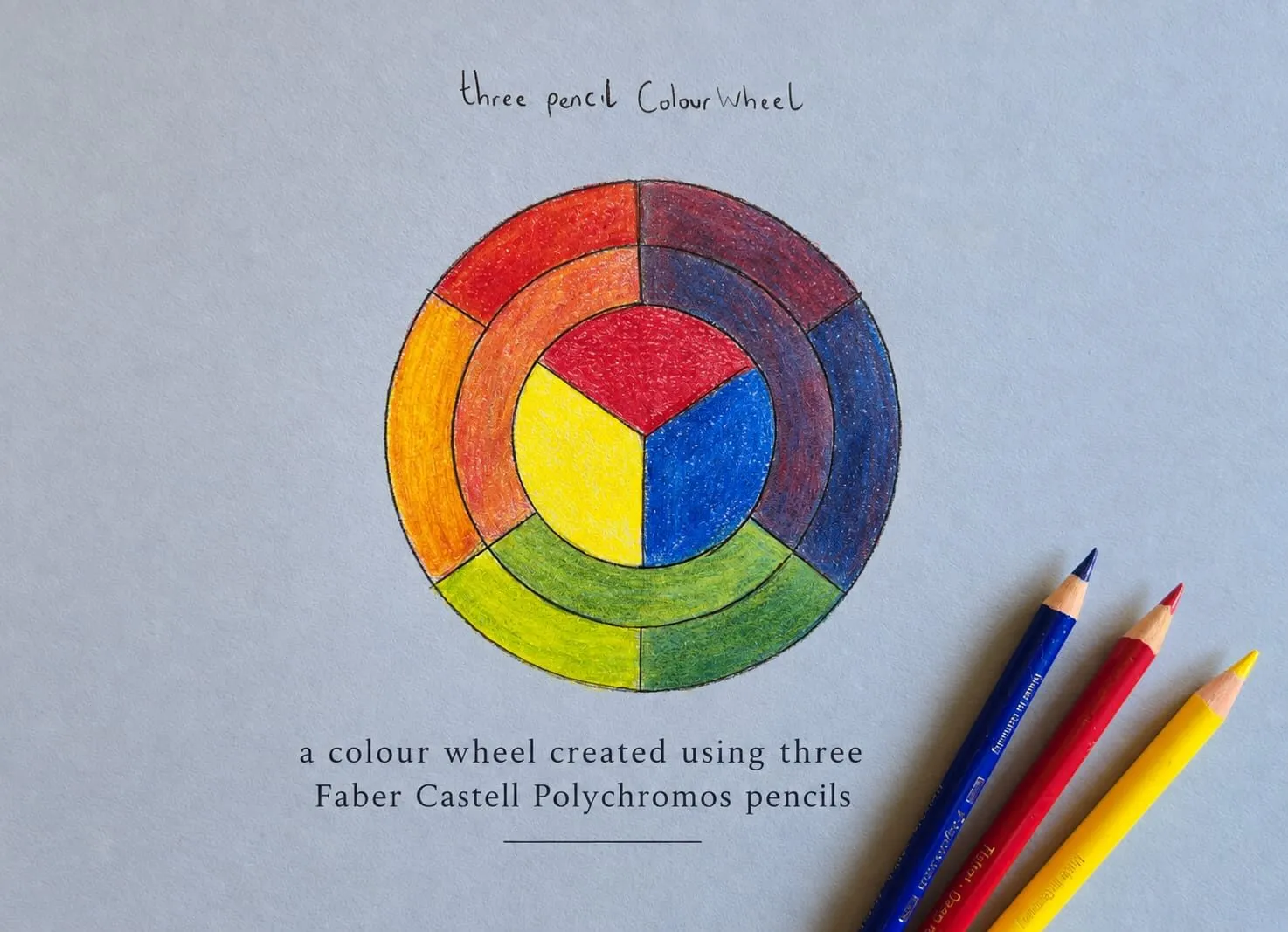
Michael’s wheel: every hue is made by layering the three pencils, not by choosing from a large set.
You need: three pencils that lean toward a red, a yellow and a blue, a sheet of paper you like to draw on (toned paper is fine), a compass or a plate to trace, and a pencil for guidelines.
- Draw a circle about 10 cm across and divide it into twelve equal segments, like a clock.
- Place the primaries in three evenly spaced segments: say the 12, 4 and 8 o’clock positions.
- Fill the secondaries between them. In the segment between red and yellow, layer light red pressure and yellow. Do the same for the other two gaps.
- Fill the tertiaries. Between a primary and a secondary, use more of the primary than the secondary. A red-orange is mostly red with a little yellow.
- Keep pressure consistent. Use the same number of layers in each segment so the wheel is comparable.
- Label what you used. Write the layer order beside each segment, so you can repeat the mix.
- Look for gaps. Note where the mixes are dull, which will usually be greens and violets.
That last step is the real lesson. Your wheel will show honestly where your pencils are strong and where you need another pencil, which links directly to the advice in how to match and mix colours with pencils.
Using the wheel when you draw
Once you have a wheel, four quick habits apply it to real work:
- Check the neighbours. If a shadow needs to feel cooler, move a step or two around the wheel toward blue rather than reaching for black.
- Reach across for muting. If a colour is too loud, layer a whisper of its opposite on top.
- Choose a scheme. Pick a wedge or a shape on the wheel as your palette. Colour harmony schemes lists the options and when each works.
- Test digitally first. Enter a base colour in the colour scheme generator to see suggested partners before you commit.
Remember that hue is only one of five things to control. A perfect scheme will still look flat if the values are similar, so plan light and dark with the value study tool and read value in drawing.
Common mistakes with the colour wheel
- Treating it as a law. Great drawings break the wheel constantly. It describes relationships, not requirements.
- Assuming pencils match the diagram. A pencil sold as “blue” may lean green or violet. Swatch first.
- Ignoring value. Two colours that are opposites on the wheel but identical in value can vibrate uncomfortably.
- Using every hue. A drawing that uses the whole wheel usually looks chaotic. Choose a segment.
A note on other wheels
You may also meet wheels with more than twelve colours, or wheels that show value and saturation as extra dimensions. These are useful once you are comfortable with the basics. A wheel with many steps shows subtle neighbours, and a three-dimensional colour model places light and dark on a vertical axis and intensity outward from the centre. But for planning pencil work, the simple twelve-colour wheel is enough. Everything else is a refinement of the same idea: colours have relationships, and you can use them.
The short version
The wheel is a map of colour relationships: neighbours blend, opposites contrast, and evenly spaced groups balance. Use the traditional red, yellow and blue wheel to plan pencil mixes, use RGB tools as a convenience, and make your own three-pencil wheel at least once. Then return to the colour theory hub for the next step.
Quick answers
Frequently asked questions
What are the three primary colours for artists?+
Traditionally red, yellow and blue. They are called primary because you cannot mix them from other colours, and the other hues on the wheel can be mixed from them. In practice, real pencil pigments are never perfect primaries, so mixes are slightly duller than the theory suggests.
What is the difference between the RYB and RGB colour wheels?+
The RYB wheel is the traditional artist's model, based on mixing pigments. The RGB wheel is based on mixing coloured light on screens, with red, green and blue as primaries. Pencils are pigment, so the RYB wheel is the better working guide, though RGB tools are handy for planning.
How many colours are on a colour wheel?+
The classic wheel has twelve: three primaries, three secondaries and six tertiaries. You can draw a simpler six-colour wheel or a more detailed one with many steps. Twelve is the standard because it is easy to read and shows every relationship you need.
Can I make a colour wheel with only three coloured pencils?+
Yes, and it is one of the best exercises for learning colour. Layer pairs of pencils to make secondaries and tertiaries. You will quickly see which mixes work and where your chosen pencils fall short.
Are colored pencils and coloured pencils the same?+
Yes. Coloured pencils is the UK spelling and colored pencils is the US spelling, and they are the same product. The wheel exercise works for both.