Books & Courses
Best Books for Coloured Pencil Artists
The best coloured (colored) pencil books by goal: layering, glossy objects, botanical, wildlife and texture, plus how to study a book properly.
This guide contains affiliate links. If you buy through them we may earn a small commission at no cost to you. How this works.
Jump to recommended products
Key takeaways
- ◆Colored Pencil Painting Bible is the essential technical book for layering, glazing, burnishing and colour theory.
- ◆Super Realism is the best guide to glossy and reflective objects such as glass, metal and food.
- ◆Botanical Drawing in Color teaches colour mixing and form through approachable plant projects.
- ◆Drawing Wildlife covers fur, feather and eye rendering in coloured pencil and graphite.
- ◆Study one book at a time: work the exercises on the paper you actually use, and keep swatches of what you learn.
Coloured pencil books tend to fall into two camps: those that teach the medium itself, and those that teach a subject through the medium. The best collections have both. You need a technical grounding in layering and colour, and you need a guide to the specific things you want to draw, whether that is a glossy pastry, a fox or a foxglove.
This list curates the titles from our wider best books to improve your drawing and specialist lists that matter most to coloured pencil artists, organised by goal. Each one earns its place by teaching something you can put on paper straight away. For the bigger picture, see how to get better at drawing.
Colored pencil is simply the US spelling of coloured pencil, so these books serve artists on both sides of the Atlantic. If you are newer to the medium, the beginner’s guide to coloured pencil drawing and the best coloured pencil sets guide make good companions, and the which pencil set quiz can narrow the choice.
Pick by goal
| Goal | Book | Author |
|---|---|---|
| Colour, layering and the painterly look | Colored Pencil Painting Bible | Alyona Nickelsen |
| Glossy and reflective objects | Super Realism | Sarah Evans |
| Botanical drawing in colour | Botanical Drawing in Color | Wendy Hollender |
| Wildlife, fur and feathers | Drawing Wildlife | J.C. Amberlyn |
| Texture and subtle shading | Drawing Realistic Textures in Pencil | J.D. Hillberry |
| Approachable realism | You Can Draw | Leonardo Pereznieto |
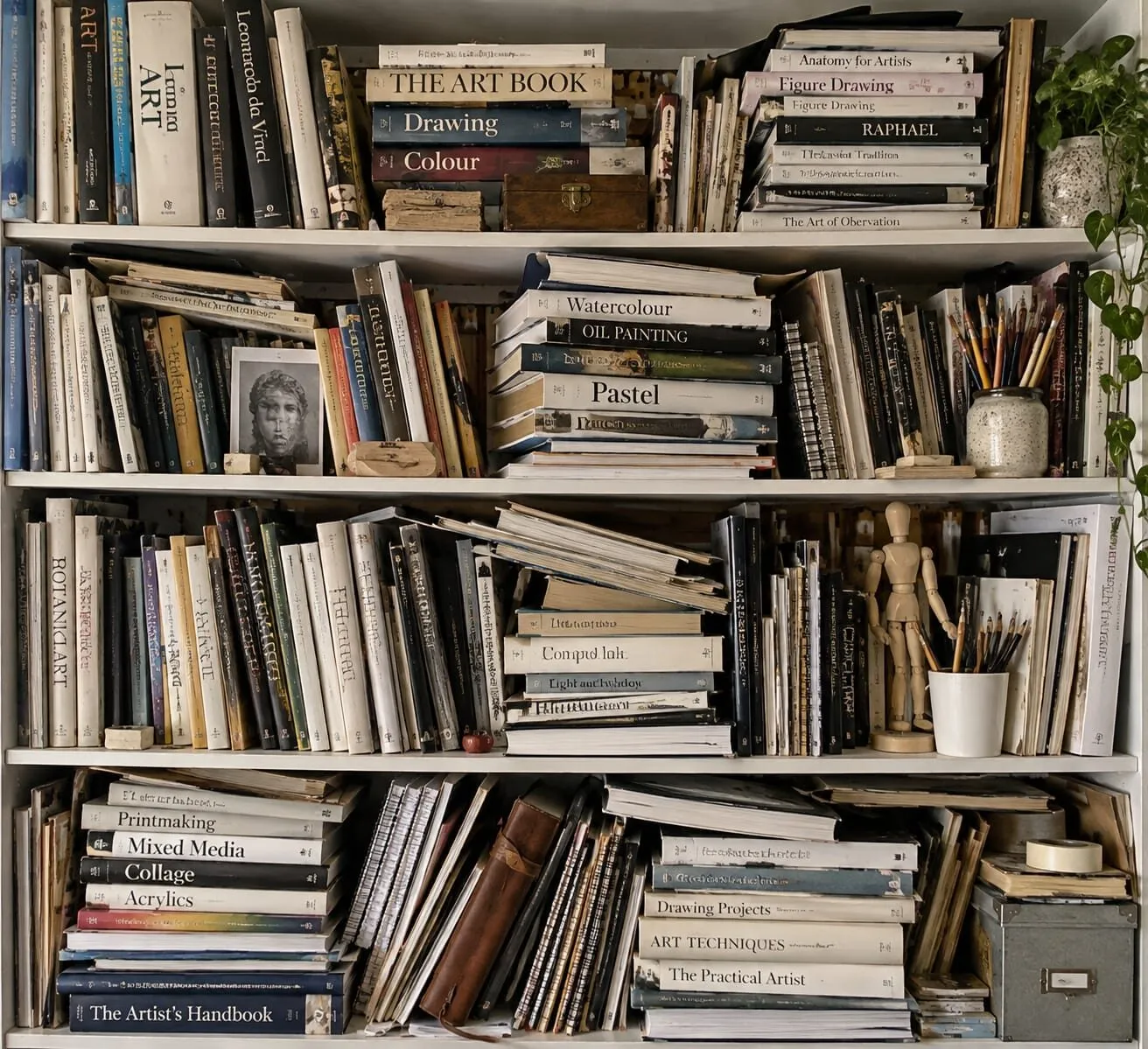
A bookshelf filled with art books and sketchbooks.
Colour and layering: Colored Pencil Painting Bible
Nickelsen is one of the most respected coloured pencil educators, and this book is a masterclass in realism. It teaches layering, glazing, solvents, burnishing and colour theory specifically for coloured pencil, and shows how to make the medium look like paint.
Best for: artists aiming for professional realism, and amateurs ready to level up.
Why it matters: if hyperrealism is your goal, this book is essential. It is dense, so treat it as a course rather than a read-through. Our technique guides on layering, blending and burnishing give a lighter first pass before you tackle the deeper material.
Glossy objects: Super Realism
Evans concentrates on everyday objects - glass, metal, food and plastic - and teaches how to make them convincingly real. Her approach is methodical and friendly, with step-by-step guidance and clear breakdowns of complicated surfaces.
Best for: still life lovers and anyone who wants better texture rendering.
Why it matters: it is one of the best books for learning how light behaves on different materials. Highlights and reflections are the whole story on shiny subjects, and this book shows how to plan them. Extend it with our guides to drawing glossy surfaces and shiny metal and reflections, and consider grey paper for these subjects.
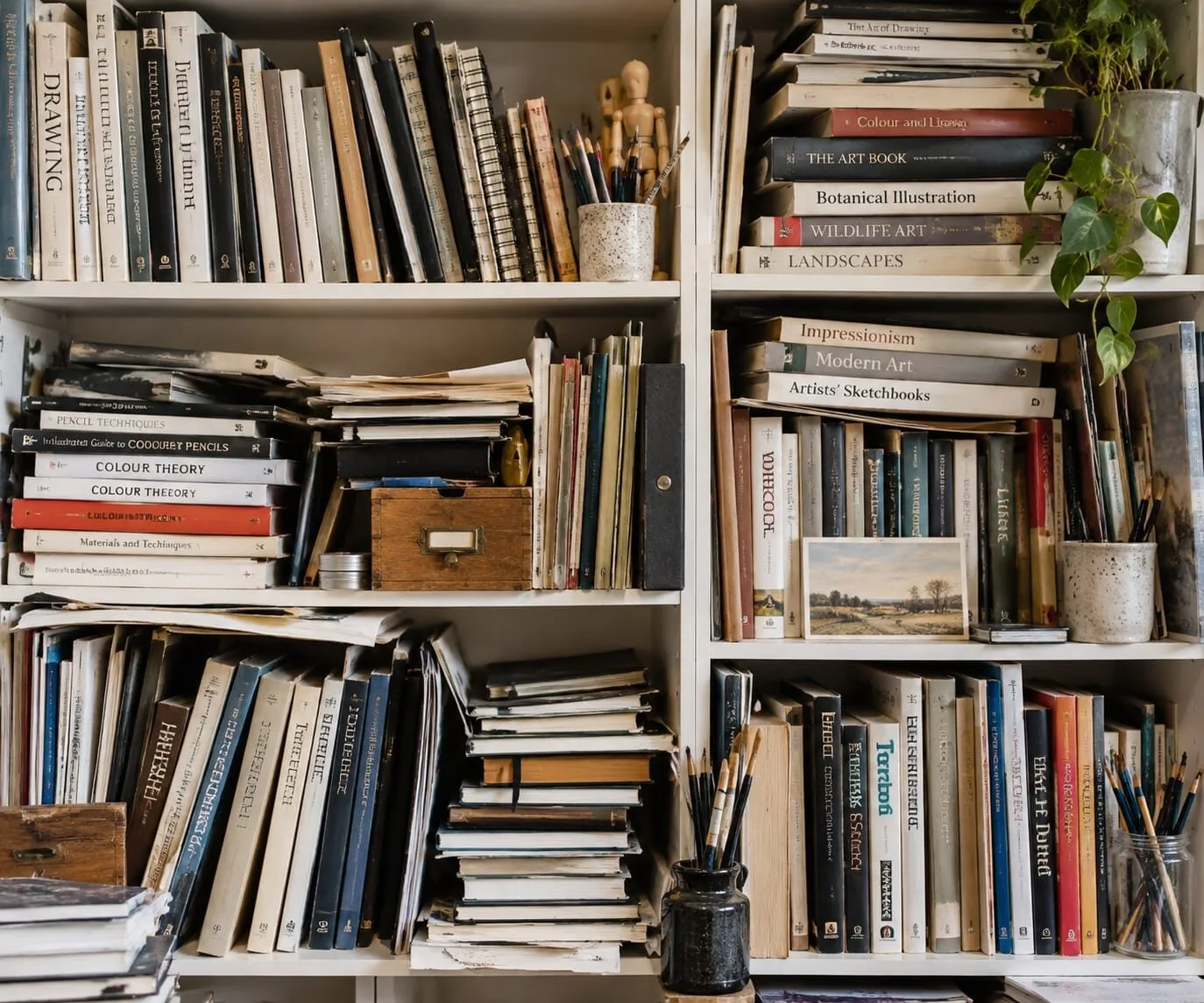
A studio bookshelf of art books, sketchbooks and brushes.
Botanical: Botanical Drawing in Color
Hollender teaches form, value, colour mixing and layering through botanical subjects, with clear, friendly, step-by-step projects that build confidence.
Best for: coloured pencil artists and amateurs learning colour theory.
Why it matters: it is one of the best books for learning botanical drawing in coloured pencil, and plant subjects are a forgiving, well-lit way to practise colour and edges. For more options, see the best books for botanical drawing.
Wildlife: Drawing Wildlife
Amberlyn focuses on wildlife realism in coloured pencil and graphite: fur, feathers, eyes and natural textures. The demonstrations are detailed but approachable.
Best for: artists who want realistic wildlife drawings.
Why it matters: wildlife realism demands texture mastery, and Amberlyn teaches it clearly. It pairs with our guide to drawing animal fur and the wider best books for animal drawing.
Texture: Drawing Realistic Textures in Pencil
Hillberry’s graphite book shows how to create wood, metal, fabric, skin and glass through subtle shading. It is graphite only, but the lessons carry directly across.
Best for: artists who want more convincing texture, especially those moving from graphite to coloured pencil.
Why it matters: texture is often the missing piece in realism, and graphite isolates value so you learn it cleanly. See also how to draw realistic textures in graphite.
Accessible realism: You Can Draw
Pereznieto breaks realistic drawing into approachable steps: shading, highlights and texture, with clear demonstrations and particular strength on reflective surfaces.
Best for: amateurs learning realism, and artists refining shading.
Why it matters: its friendly tone makes realism feel achievable, and it makes a good bridge before the more demanding technical titles.
How to study a coloured pencil book effectively
- Match the materials first. Results depend on paper and pencil. Note what the author uses, and expect your results to differ if you use a different paper or brand. Our best paper for coloured pencils helps you choose.
- Copy the small exercises before the big projects. Swatch layering, blending and burnishing on a scrap sheet.
- Keep a swatch page. Record which pencils, pressure and layer order produced each effect.
- Follow one project all the way through. Finishing teaches things skipping does not.
- Then draw something of your own using the same method. That is how technique becomes skill.
- Revisit after a month. Compare a repeat of an early exercise with your first attempt.
Building a small coloured pencil library
Six books is plenty, and you do not need all of them at once. A sensible order for most artists is: an observation or accessible realism book first, so that your drawing is accurate before colour complicates it; then Colored Pencil Painting Bible for technique; then whichever subject book matches your interests. Someone who mainly draws food and objects should prioritise Super Realism; someone who draws animals or pets should choose Drawing Wildlife; someone who likes plants should begin with Botanical Drawing in Color.
What books cannot tell you
Books describe one artist’s materials and habits, and yours will differ. Pencil brands, paper choice, pressure and even room lighting change how a technique behaves. Treat every demonstration as a starting point, and test it on your own paper. If a book recommends a technique that seems to fail for you, the cause is usually a different surface. Grey and toned papers, for instance, behave quite differently from smooth white paper, as our guide to grey paper for coloured pencil explains. Wax-based and oil-based pencils also layer differently, which our comparison of wax versus oil-based coloured pencils sets out.
Books plus practice
Colour is a skill of judgement, and judgement comes from repetition. After each chapter, make a small study of your own using the method: a single fruit, a folded cloth or a leaf. Keep the study small so that you finish it. If colour choice troubles you, the colour scheme generator is a quick way to test harmonies before you commit pencil to paper, and our guide to colour harmony schemes explains why some combinations work.
Which pencils to use with these books
The authors work with various brands, so check each book’s materials list before buying pencils. Our reviews of the best coloured pencils and of Polychromos give general guidance, and no book requires a particular brand to learn from. Start with a modest set and expand as you find gaps.
Common questions before you buy
Many artists ask whether they should wait until they are more experienced before buying a technical title. In most cases the answer is no, provided you accept that some chapters will make more sense later. Read the early sections on materials, pressure and layering straight away, and return to the advanced glazing and solvent chapters when you have a few finished drawings behind you. Another frequent worry is edition and availability: books go in and out of print, so check a current listing before ordering, and consider second-hand copies of older titles, which are often perfectly good for learning.
The short version
Buy Colored Pencil Painting Bible for technique, Super Realism for glossy objects, Botanical Drawing in Color for colour mixing through plants and Drawing Wildlife for fur and feathers. Add Hillberry for texture and Pereznieto if realism feels intimidating. Work through them one at a time, on the paper you actually use.
Where to buy
Recommended products
Affiliate links. We may earn a small commission if you buy, at no extra cost to you. Why?
Book · Alyona Nickelsen
Colored Pencil Painting Bible
A deep technical guide to layering, glazing, solvents and colour for coloured pencil.
Buy on AmazonAffiliate link · opens Amazon
Book · Sarah Evans
Super Realism: How to Draw Amazingly Lifelike Objects with Coloured Pencils
Step-by-step lessons on rendering glass, metal, food and plastic.
Book · Wendy Hollender
Botanical Drawing in Color
Colour mixing and layering through botanical subjects.
Buy on AmazonAffiliate link · opens Amazon
Book · J.C. Amberlyn
Drawing Wildlife
Realistic fur, feathers and eyes in coloured pencil and graphite.
Buy on AmazonAffiliate link · opens Amazon
Book · Leonardo Pereznieto
You Can Draw: Simple Techniques for Realistic Drawings
An approachable route into shading, highlights and texture.
Buy on AmazonAffiliate link · opens Amazon
Book · J.D. Hillberry
Drawing Realistic Textures in Pencil
A graphite master's guide to wood, metal, fabric, skin and glass.
Buy on AmazonAffiliate link · opens Amazon
Quick answers
Frequently asked questions
What is the best book for learning coloured pencil?+
Alyona Nickelsen's Colored Pencil Painting Bible is the strongest all-round technical choice, covering layering, glazing, solvents, burnishing and colour theory. For a friendlier start, Wendy Hollender's Botanical Drawing in Color teaches colour mixing through simple plant projects, and Sarah Evans' Super Realism suits still life.
Do coloured pencil books teach drawing or just technique?+
Mostly technique, so they work best once you can draw reasonably accurately. If proportion and seeing are your weak points, start with an observation book such as Keys to Drawing or Drawing on the Right Side of the Brain, and then move to the coloured pencil specialists.
Are graphite books useful for coloured pencil artists?+
Yes. J.D. Hillberry's Drawing Realistic Textures in Pencil teaches convincing texture and subtle shading in graphite, and those skills transfer directly to coloured pencil. Value control is the same problem in both media, so graphite practice strengthens your colour work.
Should I buy several books or focus on one?+
Focus on one at a time. Work through its exercises using your own pencils and paper, then choose the next book by the gap you find. A single book studied properly will improve your work more than several skimmed.