Books & Courses
How to Overcome Artist's Block
Practical ways to overcome artist's block: find the cause, start small, use constraints and timed studies, change materials, use prompts and build a routine.
Key takeaways
- ◆Artist's block is usually fear, fatigue or a lack of direction, not a lack of ability. Naming the cause tells you which fix to try.
- ◆Start smaller than feels reasonable: five minutes, one object, one pencil. Momentum matters more than quality.
- ◆Constraints, timers and prompts replace the paralysing question 'what should I draw?' with a simple task.
- ◆Changing materials, subject or scale can break a rut without changing your goals.
- ◆A light routine and a low bar for what counts as a session prevent blocks from building up.
Every artist who draws regularly hits days, and sometimes months, when the work will not come. The page stares back, the ideas are flat, and the thought of starting is unpleasant. Artist’s block feels like a verdict on your talent, but it is almost always something more ordinary: a mix of pressure, tiredness and too many choices.
The good news is that blocks respond to practical action. This guide helps you work out what is behind yours, then gives you a set of time-honoured fixes: small starts, constraints, timed studies, changing materials, prompts, routines and ways of dealing with perfectionism. Keep whichever ones fit and ignore the rest. If you want a steady supply of daily tasks, the 30-day drawing challenge and drawing ideas for beginners are designed for exactly this.
Find the cause first
Different blocks need different medicine. Ask yourself which of these sounds most like you.
| Feels like | Likely cause | Best first move |
|---|---|---|
| “Whatever I draw will be bad” | Perfectionism or fear | Low-stakes, timed, disposable drawing |
| “I have no idea what to draw” | Too many options, no direction | Prompts and constraints |
| “I am too tired or flat” | Burnout, overwork | Rest, then easy, enjoyable drawing |
| “Everyone is better than me” | Comparison | Compare with your own earlier work |
| “I am bored of my subject” | A rut | Change subject, scale or materials |
| “I have a big piece and cannot begin” | Overwhelm | Break it into small steps |
Many blocks are a blend, but one cause usually dominates. Naming it takes away some of its power.
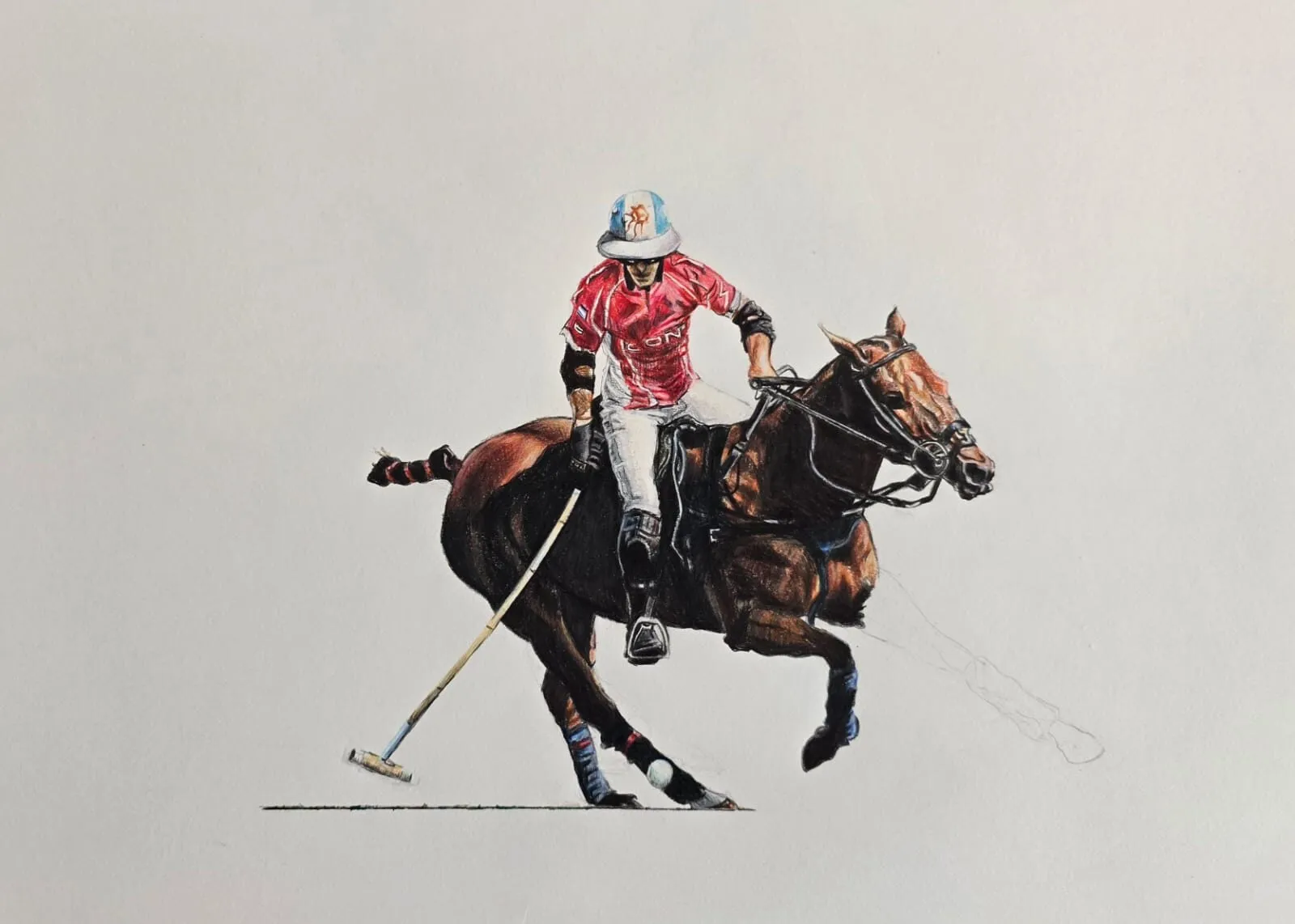
A polo player on a galloping horse drawn in coloured pencil. Drawing by Michael Brace.
Start smaller than feels reasonable
The biggest obstacle is starting. Shrink the task until it is almost laughable.
- Set a five-minute timer. Tell yourself you can stop when it rings.
- Choose one simple object within reach: a cup, a shoe, your hand.
- Use one pencil. Do not plan, do not choose a paper you are precious about.
- Draw until the timer ends. Then decide whether to continue.
More often than not you will keep going, but even if you do not, you have drawn, and that keeps the habit alive. A sketchbook you never worry about is the best tool for this. Our guide to how to practise drawing daily describes a short session structure that works well when you are low on energy.
Use constraints to cut the choices
A blank page with unlimited options is frightening. Constraints turn a huge question into a small one.
- Limit the subject: only things on your desk, only your hands, only one window of your house.
- Limit the tools: a single pencil, or three colours.
- Limit the time: 10 minutes, no more.
- Limit the size: a thumbnail-sized drawing, no bigger than a postcard.
- Limit the tones: only three values, using the value study tool to check.
- Limit the palette: see limited palette drawing and try the colour scheme generator for a ready-made set of colours.
Constraints do not reduce creativity, they direct it. A lot of good work comes from a problem set by a restriction.
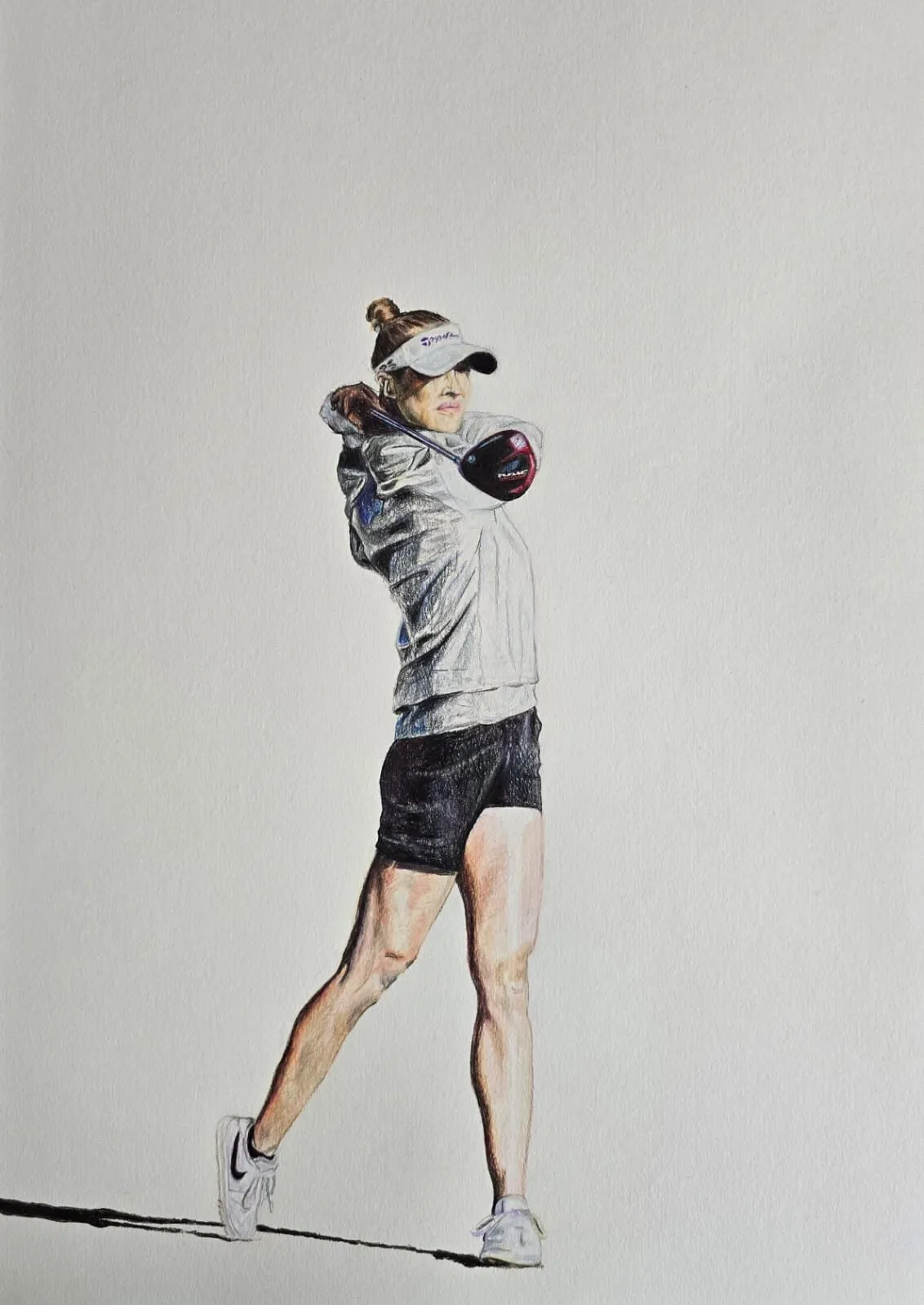
A golfer mid-swing drawn in coloured pencil. Drawing by Michael Brace.
Timed studies
A timer takes away the pressure to produce a masterpiece. Choose a subject, set 10, 20 or 30 minutes, and complete a whole small drawing in that time. When the timer ends, stop, even if the drawing is incomplete. Time limits force decisions, reveal which details matter and rebuild confidence because you finish something each time. They also give you a safe way to try things. Repeat the same subject weeks later and compare; the progress is often encouraging.
Change something
If you are bored or stuck in a rut, change one variable.
- Change the subject. Switch from portraits to objects, or from objects to landscapes. See drawing ideas for beginners for fresh ones.
- Change the material. Draw with graphite if you normally use colour, or swap to a limited set of coloured pencils (colored pencils in the US). Toned paper changes how you think about light, as explained in why use grey paper for coloured pencil.
- Change the scale. Draw much bigger or much smaller than usual.
- Change the place. Draw in a cafe, a park or another room.
- Change the hand. Draw with your non-dominant hand for a few minutes; it removes pressure to be neat.
- Change the goal. Instead of a finished piece, aim to learn one thing, such as edges, shadows or a colour combination.
Prompts and structured plans
When the question “what should I draw?” is the block, let something else answer it.
- Draw the next item on a list. Use the 30-day drawing challenge and do today’s task, nothing else.
- Pick a prompt at random from the ideas list: close your eyes and point.
- Use a rotating menu. Monday gesture, Tuesday contour, Wednesday value study and so on.
- Draw a colour. Choose a two-colour combination and find something that matches it. The palette from photo tool can pull colours from a picture to start you off.
- Follow a lesson. Working through a structured guide such as how to draw basic forms and shading means someone else has already decided what to do.
Deal with perfectionism
Perfectionism is one of the most common causes of block, because it makes starting risky. A few habits help:
- Draw in a cheap sketchbook and let it be bad.
- Make many small drawings instead of one big one. Ten quick studies beat one agonised piece.
- Set “ugly drawing” days, where the goal is to make a messy page on purpose.
- Focus on process, such as “I practised edges”, not results.
- Separate making from judging. Draw first, evaluate later, and only against your own earlier work.
- Finish things. A finished imperfect drawing teaches more than an unfinished ideal one.
Build a routine that prevents blocks
Regular practice keeps blocks small. A light routine means you never have to summon motivation from nothing.
- Same time, same place. A fixed slot turns drawing into a habit.
- Materials ready. Leave a pencil and sketchbook out. If setup is a chore, you will draw less. See how to set up a home drawing studio for a simple setup.
- A minimum session. Decide that five minutes counts, so a bad day does not break the chain.
- Rest on purpose. Plan days off so they do not feel like failure.
- Keep dated pages. Looking back at your own progress is one of the best cures for discouragement.
Feed your eyes
Sometimes you are empty because nothing has gone in. Look at drawings by artists you admire, visit a gallery, or read a good book. Our master draughtsmen to study and best books to improve your drawing lists are good places to start. Try copying a small section of a favourite drawing for study; it feels productive without asking you to invent anything.
When rest is the answer
Not every block should be attacked. If you are exhausted, stressed or overcommitted, forcing yourself to draw may make things worse. Take a few days off, sleep, walk and come back to easy, pleasurable drawing. If a long block comes with low mood, loss of interest in other things or exhaustion that affects daily life, it may be about more than drawing, and a doctor or counsellor can help.
A one-week reset
- Day 1: five-minute contour drawing of an object on your desk.
- Day 2: three 10-minute studies of the same object from different angles.
- Day 3: a value scale and a shaded sphere.
- Day 4: a copy of a small part of a master drawing.
- Day 5: a drawing in a material you rarely use.
- Day 6: a longer piece of something you enjoy, with no expectations.
- Day 7: look through the week’s pages and note what you liked.
The short version
Name the cause of your block, then shrink the task: five minutes, one object, one pencil. Use constraints, timers and prompts to remove choices, change a variable when you are bored, go easy on perfectionism and keep a minimal routine so blocks never get large. If you are simply exhausted, rest.
Quick answers
Frequently asked questions
What causes artist's block?+
Common causes are perfectionism, fear of wasting good paper or a finished piece, tiredness or burnout, comparing yourself with others, having too many options and a lack of a clear next step. Most blocks are a mix of these, and identifying which one applies helps you choose a fix that works.
How do I start drawing when I have no motivation?+
Lower the bar. Promise yourself five minutes with a simple subject such as an object on your desk, and set a timer. Starting is the hardest part, and once the pencil is moving the resistance often fades. If it does not, stop after five minutes and count it as a success.
How long does artist's block last?+
It varies from a day to several months. Short blocks often pass after rest or a change of subject. Longer ones usually need a change in routine, materials or goals. If your block comes with low mood or exhaustion that affects other parts of life, consider speaking to a health professional.
Can colored pencils help break a creative block?+
They can, because a small set is low-stakes and playful. Try a quick study in colored pencil (coloured pencil in the UK) with only three or four colours and a time limit. Swatching colour combinations on scrap paper is a gentle way to restart without the pressure of a finished piece.