Books & Courses
Master Draughtsmen to Study
Ten great draughtsmen whose drawings teach the most, from Leonardo and Rembrandt to Sargent and Bargue, plus how to study a master drawing properly.
Key takeaways
- ◆Studying master drawings shows you decisions - where a line thickens, an edge softens, a shadow simplifies - that finished paintings hide.
- ◆Bargue, Durer and Ingres are the friendliest starting points for beginners; Leonardo, Prud'hon and Sargent suit realism.
- ◆Degas, Michelangelo and Rembrandt are richest for gesture, movement and expressive line.
- ◆Copy, analyse, then thumbnail: copying trains the hand, analysis trains the eye, thumbnails prove you understood.
- ◆Study originals in person when you can; reproductions flatten tone and paper texture.
Studying master drawings is one of the fastest ways to improve your own. You see how artists think on paper: their hesitations, corrections and pressure changes, and the astonishing economy with which they build form. A finished painting hides most of that, but a drawing keeps the decisions on show.
This guide picks ten artists whose drawings are especially instructive, says what each teaches and who should look first, and then shows a method for studying a drawing so you actually learn something. It suits beginners learning proportion as much as experienced artists refining realism. For the wider path, see how to get better at drawing.
To apply what you learn, try a lesson on how to draw shadows and light or how to draw a portrait from a photo, then copy a master drawing in graphite or colored pencil on toned paper.
The ten artists at a glance
| Artist | Best for | Teaches |
|---|---|---|
| Leonardo da Vinci | Anatomy, proportion, subtle tone | Seeing, controlled hatching |
| Michelangelo | Gesture, dynamic poses | Sculptural form, foreshortening |
| Albrecht Durer | Detail, texture, accuracy | Precision, cross-hatching |
| Rembrandt van Rijn | Expressive mark-making | Character, simplification |
| Jean-Auguste-Dominique Ingres | Clean line, proportion | Contour, restraint |
| Edgar Degas | Movement, atmospheric shading | Fleeting pose, pastel and charcoal |
| John Singer Sargent | Confident, economical marks | Value control, form |
| Kathe Kollwitz | Expressive realism | Value, mood, storytelling |
| Pierre-Paul Prud’hon | Soft, luminous shading | Black and white chalk, subtlety |
| Charles Bargue | Foundational skills | Structured copying |
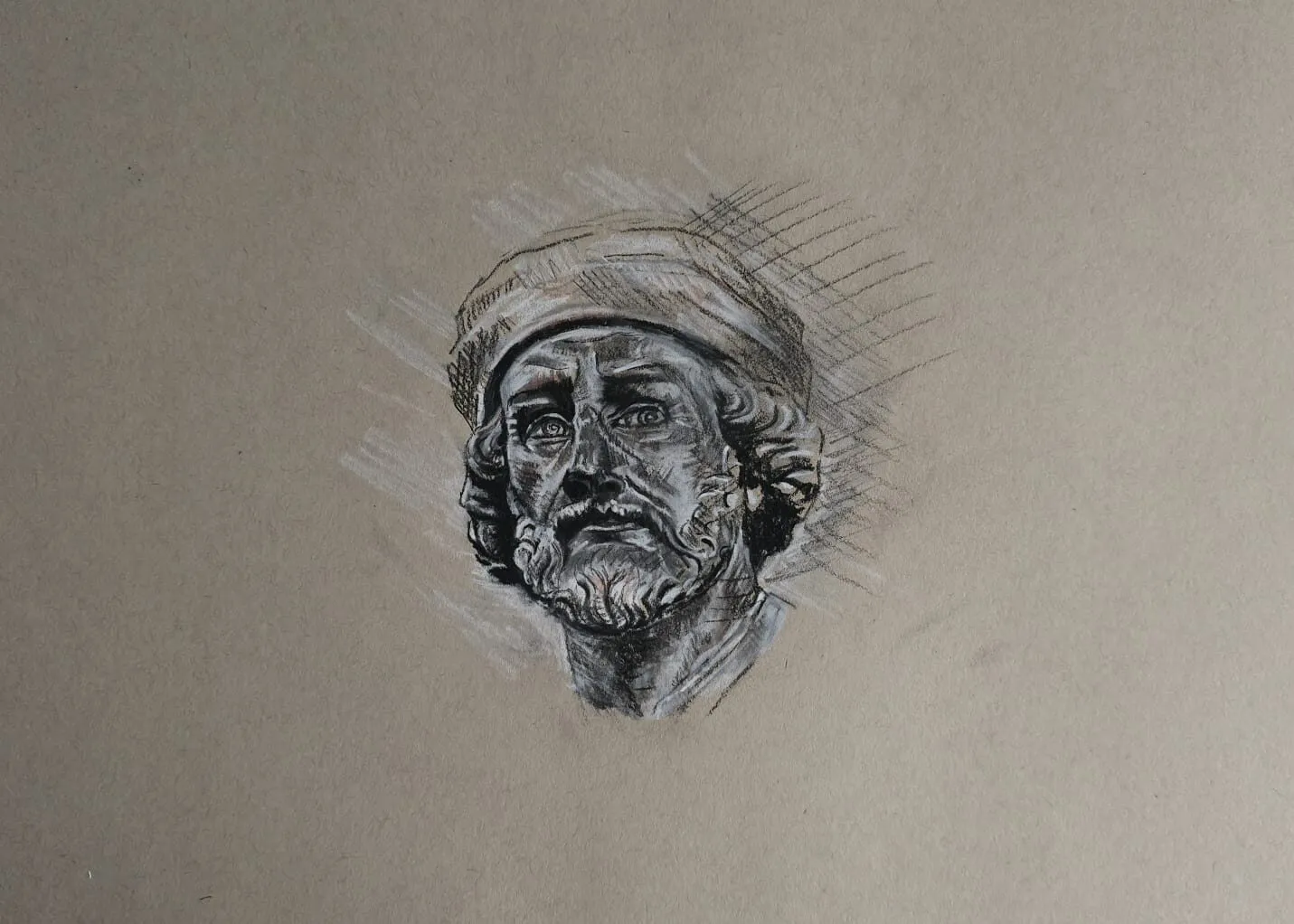
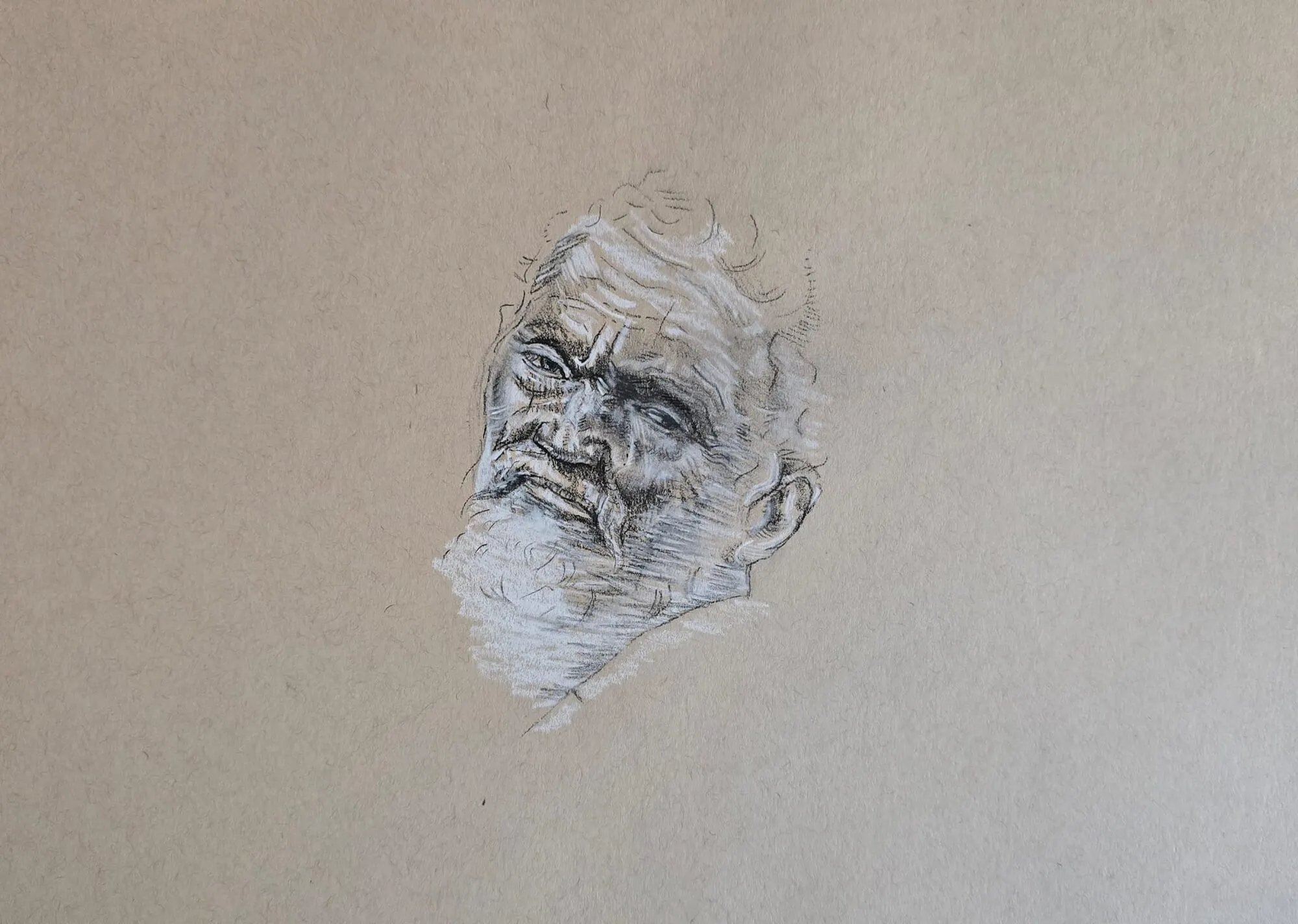
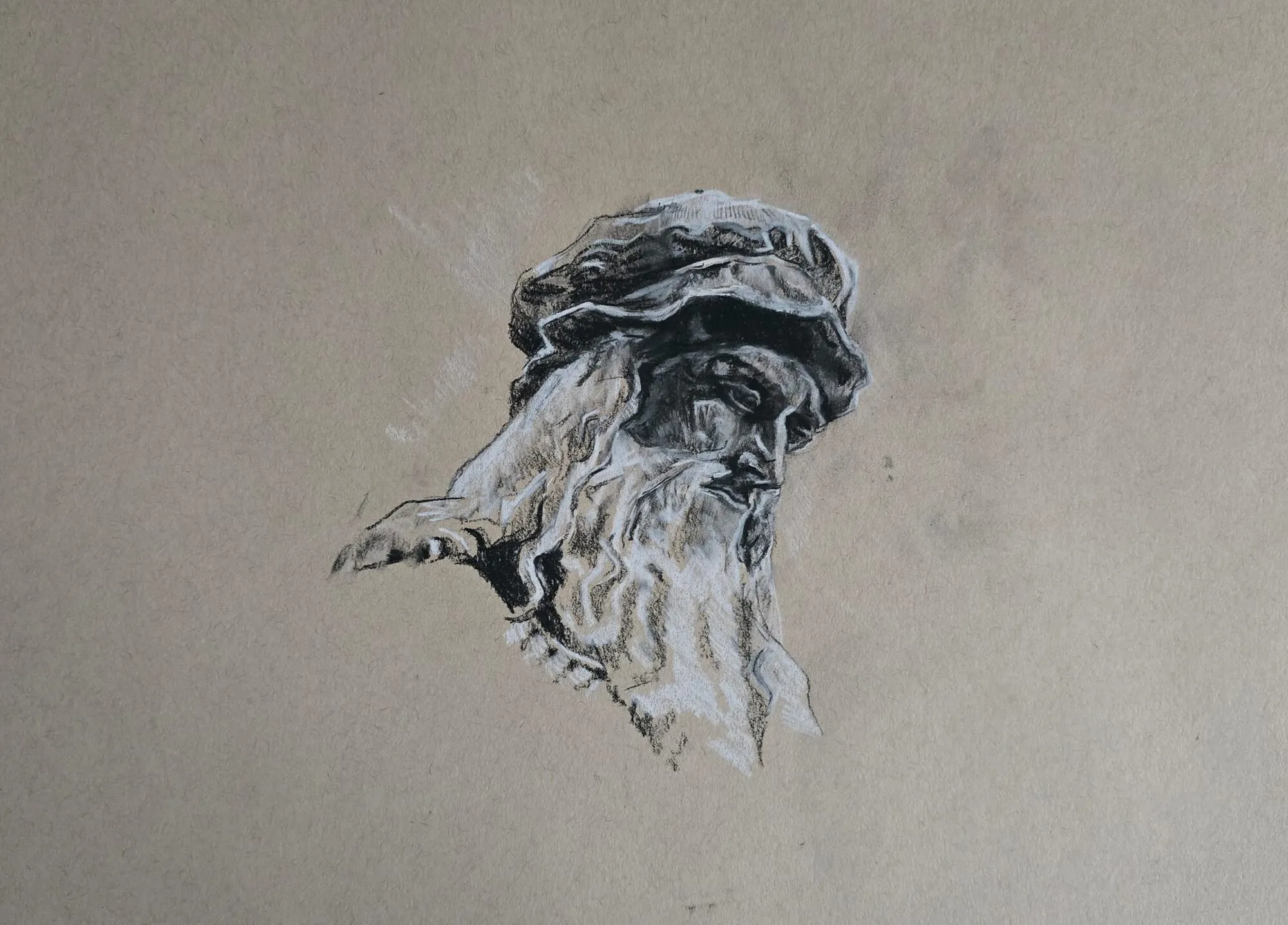
A head study of a bearded man wearing a cap in dark and white pencil on toned paper. Drawing by Michael Brace.
1. Leonardo da Vinci
The master of observation, anatomy and subtle shading. His anatomical studies show extraordinary precision, while his portraits and figure sketches reveal delicate shading and confident linework.
Best for: artists learning anatomy, proportion and subtle tonal transitions.
What to study: the controlled hatching, the clear structure and how drawings reveal the thinking behind them. Leonardo teaches you how to see, not just draw.
2. Michelangelo Buonarroti
Dynamic anatomy and powerful gesture. His figures feel sculptural, with bold lines and dramatic shading.
Best for: artists wanting to improve gesture, anatomy and dynamic poses.
What to study: the strong, confident lines and the way form is understood as three-dimensional mass, which makes his work excellent for foreshortening. He shows how anatomy can be expressive, not just accurate.
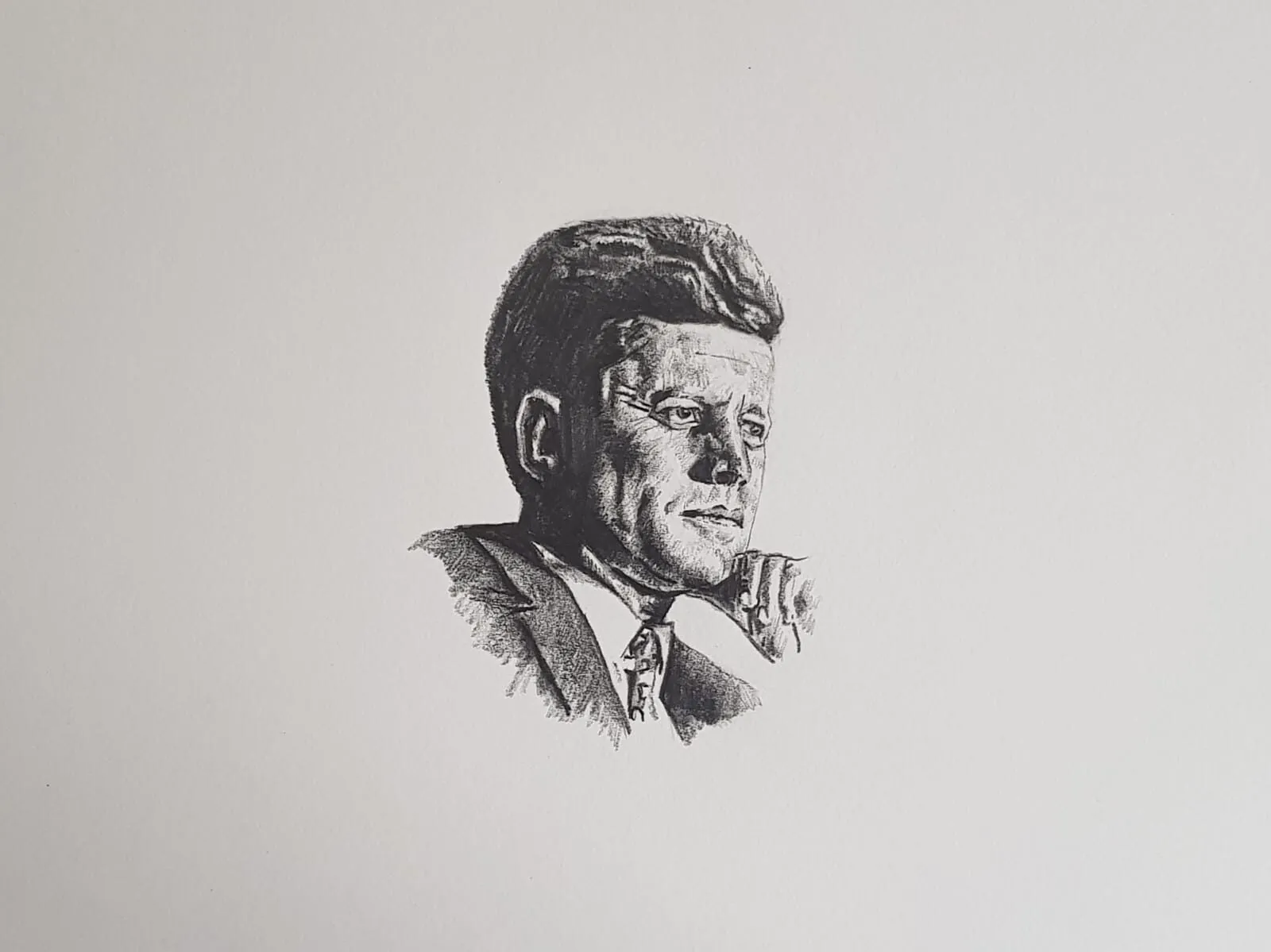
A graphite portrait of John F. Kennedy. Drawing by Michael Brace.
3. Albrecht Durer
Precision, detail and technical mastery. His studies of animals, plants and people show meticulous observation and control.
Best for: artists learning detail, texture and accuracy.
What to study: the beautiful cross-hatching, botanical and animal studies and strong sense of proportion. Durer teaches patience, discipline and technical excellence, which is why he also appeals to botanical artists; see best books for botanical drawing.
4. Rembrandt van Rijn
Expressive linework and emotional depth. Rembrandt’s drawings are loose and full of character, capturing emotion with minimal lines.
Best for: artists wanting expressive mark-making and confident gesture.
What to study: the loose, energetic lines and the handling of light and shadow. He shows how to simplify without losing meaning, and how to draw with personality.
5. Jean-Auguste-Dominique Ingres
Elegant linework and precise proportion. His portraits are some of the finest examples of line economy in art history.
Best for: artists learning clean linework and proportion.
What to study: elegant, controlled lines and facial proportion, and how contour alone can convey form. Ingres proves that a single line can carry enormous power.
6. Edgar Degas
Movement, gesture and atmospheric shading. His drawings, especially of dancers, are masterclasses in movement, and his pastel and charcoal works show how to build atmosphere.
Best for: artists wanting to improve gesture, movement and expressive shading.
What to study: the gesture, the sense of movement and how fleeting poses are captured. Degas shows how to draw energy, not just anatomy.
7. John Singer Sargent
Effortless linework and confident mark-making. His charcoal portraits are legendary, using bold strokes to create form with astonishing efficiency.
Best for: artists wanting confident, economical mark-making.
What to study: the decisive strokes, value control and strong sense of form. Sargent teaches confidence: every stroke has intention. Our guide to value in drawing covers the underlying principle.
8. Kathe Kollwitz
Emotion, drama and powerful charcoal technique. Her drawings are raw, emotional and technically brilliant, using value and texture to convey mood.
Best for: artists wanting expressive realism and dramatic shading.
What to study: the strong value contrasts and beautiful charcoal handling. Kollwitz shows how drawing can be both technical and deeply human. See also graphite versus charcoal.
9. Pierre-Paul Prud’hon
Soft, luminous shading and classical elegance. His figure drawings are ethereal, with soft transitions, delicate highlights and beautifully controlled values.
Best for: artists learning soft shading and classical realism.
What to study: the tonal transitions and the use of black and white chalk on toned paper, with strong anatomical understanding beneath. Prud’hon teaches how to create light that feels alive. Toned-paper working also connects to why use grey paper for coloured pencil.
10. Charles Bargue
The foundation of academic drawing training. The Bargue Drawing Course is still used in ateliers worldwide, and its plates teach proportion, value and accuracy through structured copying.
Best for: amateurs building foundational skills, and experienced artists refining precision.
What to study: the clear, structured exercises. Bargue is the backbone of classical drawing education, and the discipline of copying his plates builds accuracy and value control.
How to study a master drawing
Admiring a drawing teaches little. Working with it teaches a lot. Use this three-step method.
- Copy it. Choose one drawing and reproduce it as faithfully as you can, at a modest size. Copying forces you to notice things you skip when just looking: where lines start, how hard the artist pressed, which edges are hard and which soft.
- Analyse it. Ask specific questions and write the answers beside your copy. Where is the darkest dark? Where does the line thicken or vanish? What was simplified? What is the overall shape of the figure or head before detail?
- Thumbnail it. Without looking, draw a small, quick version of the drawing’s main shapes and tonal pattern (three or four values). If you can do this, you understood its structure.
Practical points
- Study originals when you can. Reproductions flatten tone and paper texture. Our best museums and galleries for drawings suggests where to look.
- Do one artist at a time. A week on Ingres’s contour teaches more than a scattered afternoon across ten artists.
- Alternate copying with life drawing. Otherwise you learn only someone else’s solutions.
- Keep a study sketchbook. Date the pages so you can revisit and compare, as described in how to practise drawing daily.
Quick recommendations
| Goal | Study |
|---|---|
| Beginners | Bargue, Durer, Ingres |
| Realism | Leonardo, Prud’hon, Sargent |
| Gesture and movement | Degas, Michelangelo, Rembrandt |
| Expressive drawing | Kollwitz, Rembrandt, Degas |
| Anatomy | Leonardo, Michelangelo, Bargue |
Building a simple study programme
You do not need a complicated plan. Choose one artist per fortnight and one drawing per week. In week one, copy the drawing and write your notes. In week two, choose a different drawing by the same artist and try to apply what you noticed to a subject of your own, such as a still life or a head from a photograph. After ten artists you will have a sketchbook full of studies, and, more importantly, a much clearer sense of the choices open to you when you draw.
Common mistakes when studying masters
The main trap is copying the surface without understanding the structure. If your copy looks similar but you cannot explain why the shadow sits where it does, you have traced with your eyes rather than studied. A second trap is choosing a drawing far beyond your level; begin with simple head studies or single figures before elaborate compositions. Finally, avoid treating a master as a style to imitate. The aim is to borrow their method of seeing, then let your own subjects and materials shape the result.
The short version
Begin with Bargue, Durer and Ingres to learn accuracy and line. Move to Leonardo, Prud’hon and Sargent for realism, and to Degas, Michelangelo and Rembrandt for life and movement. For each drawing, copy it, analyse it and thumbnail it from memory. Pair this with a good book or course, and with real drawing from life.
Quick answers
Frequently asked questions
Which master should a beginner study first?+
Charles Bargue is the best first choice because his plates were made for structured copying and teach proportion, value and accuracy. Durer and Ingres are also good for beginners, one for precise observation and hatching, the other for elegant, controlled contour and facial proportion.
Is copying master drawings good practice?+
Yes, when you do it thoughtfully. Copying trains your hand and eye, and shows how experienced artists build form with limited marks. Do it alongside drawing from life so you are not only replicating someone else's solutions, and add a written or thumbnail analysis for each study.
Which artists are best for learning portrait drawing?+
Ingres for contour and proportion, Leonardo for subtle shading and anatomy, Sargent for confident, economical mark-making and Rembrandt for character and light. Prud'hon is excellent for soft tonal transitions in chalk. Bargue's plates give a structured exercise in facial structure.
Should I study master drawings or paintings?+
Drawings are usually more instructive for improving drawing, because you can see the marks, corrections and process directly. Paintings are useful for composition and colour, but the finished surface hides how the forms were constructed. Start with drawings, then look at paintings for colour.