
Graphite & Charcoal
Best Drawing Pencils for Artists: What Serious Work Needs
How to choose graphite drawing pencils for serious work: consistency, point retention, range, categories, and kits for portrait, wildlife and botanical drawing.
This guide contains affiliate links. If you buy through them we may earn a small commission at no cost to you. How this works.
Jump to recommended products
Key takeaways
- ◆For serious work, look for consistency between pencils of the same grade, good point retention, smooth laydown and a usable range of grades.
- ◆Main categories are wooden pencils, woodless graphite, lead holders, graphite sticks and charcoal pencils, each with a different job.
- ◆Build a kit around your subject: portraits need a careful mid-range and deep darks, wildlife needs texture and layering, botanical needs fine control.
- ◆A range such as Derwent Sketching pencils is an example of a graded artist line, but check the current range and test the grades on your paper.
- ◆Paper, erasers and a sharpener affect results as much as the pencil itself, so budget for them too.
Once you pass the beginner stage, pencils stop being interchangeable. You start noticing the grade that skips on your paper, the core that snaps inside its case, the dark that will not go dark and the set where two pencils look identical. Choosing pencils for serious work is less about brand loyalty than about knowing what to check.
This guide sets out what to look for in a drawing pencil, the main categories and what each is for, and suggested kits for portrait, wildlife and botanical work. It mentions the Derwent Sketching range as an example of a graded artist line, in general terms, without claims about specifications you should verify on the maker’s current information. If you are new to grades, start with graphite pencil grades explained, and for a beginner-focused set see best drawing pencils for beginners.
What to look for
Consistency
A pencil set is only useful if each grade behaves as expected, and the steps between grades feel even. Consistency means a 2B is similar to the next 2B you buy, the core is uniform with no gritty spots and the tonal jump from one grade to the next is predictable. You can check by swatching each grade, and the pencil grade chart shows a neat way to compare.
Point retention
For detail, a pencil needs to hold its point. Harder grades hold better, but the quality of the core matters too. A crumbly core breaks under pressure or in the sharpener, and a core that is not centred in the wood sharpens unevenly and snaps. A good pencil sharpens cleanly to a long point without the lead falling out.
Smooth laydown
Graphite should glide and deposit evenly. Gritty cores scratch the paper and leave uneven tone, especially in pale layers, so you should see a smooth, steady mark at light pressure. Soft grades should give rich darkness without being greasy or shiny too quickly.
Range and depth of dark
Serious work often needs a long tonal range. A set that goes from a hard grade for fine layout to a very soft one for deep darks gives freedom, provided the dark end is genuinely dark and the pale end is genuinely pale. A range that looks wide on the tin but bunches in the middle is less useful.
Construction
Check that the wood is sound, the core is firmly glued and the case is easy to sharpen. The print on the barrel should be clear and readable so you can identify grades quickly, since it is easy to mix pencils up in a busy session.
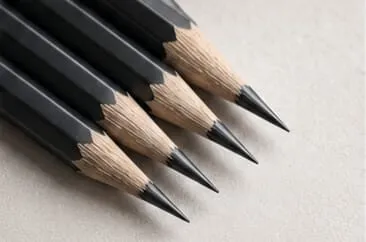
A group of sharpened black pencils on textured paper.
Categories of drawing pencil
Wooden graphite pencils
The standard artist pencil: a graphite core in a wooden case. They sharpen to a point, are available in a wide range of grades and suit almost all drawing, from fine detail to shading. They are the best starting point. The best graphite pencils for drawing guide looks at them in depth.
Woodless graphite pencils
These are solid graphite in a thin lacquer, with no wood. They give more graphite to work with, are excellent for broad side-of-lead shading and cover large areas quickly. They are heavier and more brittle, less suited to a fine point, and they can be messier. Good as a supplement for tonal areas.
Lead holders (clutch pencils)
A holder grips a thick lead, often 2 mm, that you sharpen to a point with a lead pointer or sandpaper. They suit artists who want the ability to shape the point exactly, and the lead is long so it lasts. They are comfortable for long sessions and useful for broad tone and expressive line. See best mechanical pencils for drawing for how they compare with thin-lead mechanical pencils.
Graphite sticks and blocks
Short, solid sticks or thick blocks of graphite, sometimes wrapped, cover large areas quickly and give very dark, rich tone. They suit broad, gestural work and backgrounds but are not for detail.
Charcoal pencils
A charcoal core in a pencil case gives deeper blacks than graphite and a matte finish, with more control than a stick. They are useful alongside graphite for darks, though the two behave differently and do not always mix well. See charcoal drawing for beginners and graphite vs charcoal.
| Category | Strength | Limit | Best role |
|---|---|---|---|
| Wooden graphite | Versatile, fine point | Needs sharpening | Core kit |
| Woodless graphite | Broad tone, fast | Fragile, no fine point | Shading |
| Lead holder | Shapeable point, refillable | Needs a pointer | Expressive work |
| Graphite stick | Big, dark areas | No detail | Backgrounds |
| Charcoal pencil | Deep matte black | Smudges, differs from graphite | Dark accents |
Derwent Sketching pencils
Derwent Sketching pencils are an example of a graded graphite range aimed at sketching and drawing, with a spread of hard to soft grades. As with any range, check the current grades and set options from the maker, then test a few on your paper. They are one of several artist-level graphite lines; compare them with other makers’ pencils by swatching, and look at how they sharpen, how smoothly they lay down and how well the darks build. The which pencil set quiz can help you decide what fits your drawing style.
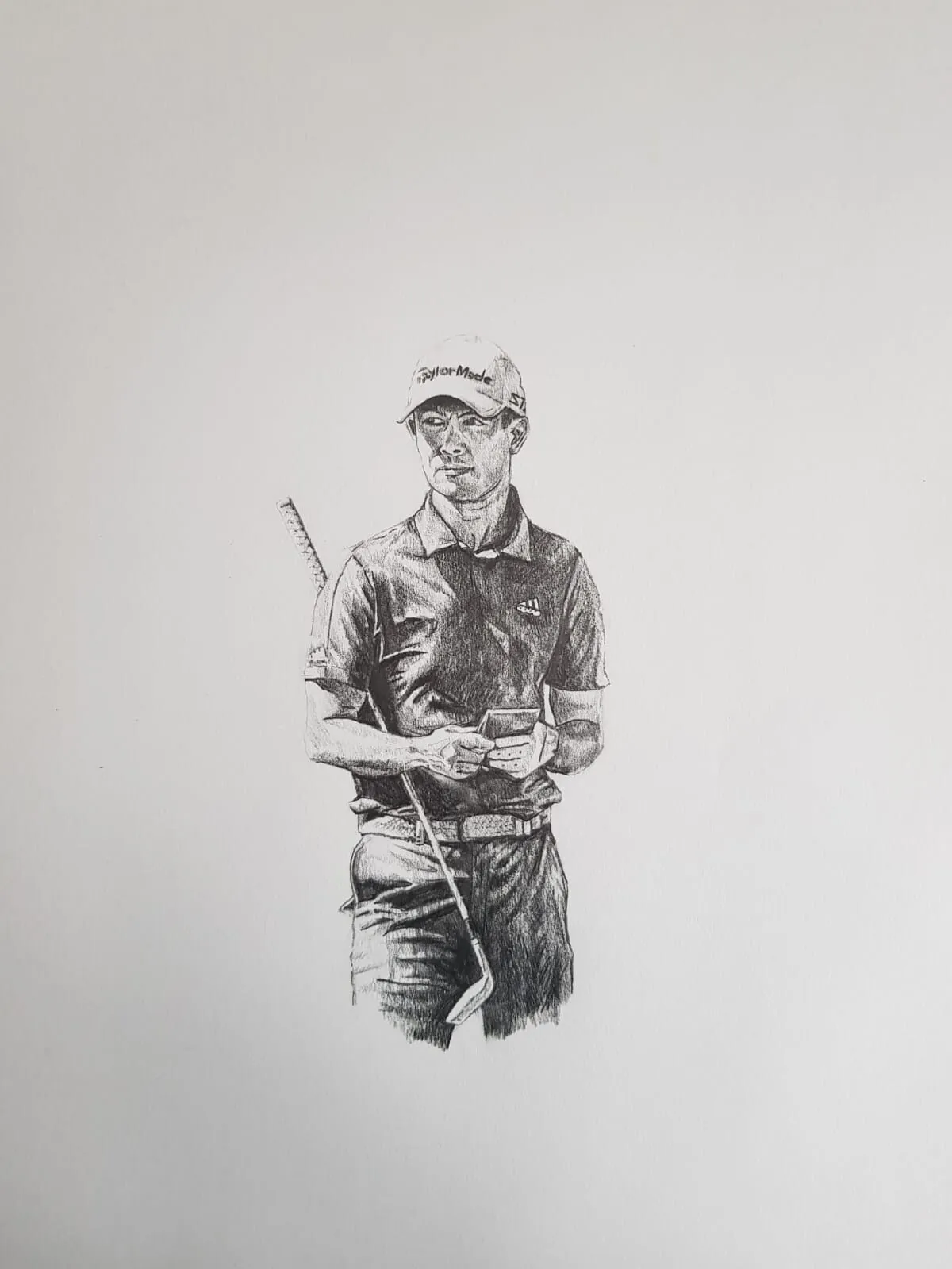
A graphite drawing of a golfer holding a club. Drawing by Michael Brace.
Kits by subject
The right kit depends on what you draw. These are starting points, not rules.
Portrait
Portraits need subtle tone across skin, so a careful mid-range matters most.
- Hard grade (2H or H) for light layout and pale first layers.
- HB and 2B for skin tone transitions and mid-values.
- 4B and 6B for shadows, hair and dark accents.
- Optional 8B for the deepest darks.
- A kneaded eraser, blending stumps and a sharp point for eyes and lips.
See how to draw a face for proportions and the portrait from a photo lesson.
Wildlife and animals
Animal drawing often needs texture, directional marks and strong contrast.
- HB and 2B for base tone and fine fur layers.
- 4B and 6B for deep shadows and dark markings.
- A woodless pencil or lead holder for broad tone on large areas such as hide.
- A fine, hard lead for whiskers and small detail.
- A kneaded eraser for lifting light hairs.
Helpful guidance: how to draw realistic textures in graphite.
Botanical and fine detail
Botanical drawing values clarity, delicate line and subtle tone.
- H to 2H for accurate, pale outlines.
- HB and 2B for form and shading.
- A fine lead in a mechanical pencil for veins and small parts.
- Smooth paper for crisp edges.
- A sharpener or knife for a precise point.
| Subject | Core grades | Extra tools |
|---|---|---|
| Portrait | 2H, HB, 2B, 4B, 6B | Stumps, kneaded eraser |
| Wildlife | HB, 2B, 4B, 6B | Woodless pencil, fine lead |
| Botanical | 2H, HB, 2B | Mechanical pencil, knife |
Sharpening and accessories
Pencils are only as good as their points. A quality sharpener or a craft knife makes a large difference, and a long point is better for shading. A sanding block re-shapes the point. Use a kneaded eraser, a precision eraser for details and a soft brush to sweep away crumbs, instead of your hand. See the guides to the best erasers for graphite and how to avoid smudging pencil drawings.
Build your kit gradually
You do not need a giant tin. A smart approach:
- Buy a small, well-spaced set or five single pencils.
- Draw with them for a month and note which grades you use most and which you miss.
- Add a softer or harder grade, a woodless pencil or a lead holder to fill the gap.
- Only then consider larger sets.
If a full set is tempting, check what it includes against what you actually use.
Who should buy what
| Level of commitment | Suggestion |
|---|---|
| Low | A small graded set and one kneaded eraser |
| Medium | Individual grades chosen to your subject plus a woodless or holder |
| High | Multiple makers compared by swatch, with lead holders, sticks and charcoal pencils for specific jobs |
The same logic applies to coloured pencil (colored pencil in the US): start small, learn your range and expand where you find limits. See best coloured pencils if you work in both.
The short version
For serious drawing, look for consistent grades, a smooth laydown, a core that holds a point and a range with real darks. Use wooden pencils as the core, add a woodless pencil or lead holder for broad tone and keep charcoal pencils for deep accents. Build kits by subject, test every pencil on your own paper and check each maker’s current range, including Derwent Sketching pencils, before buying.
Where to buy
Recommended products
Affiliate links. We may earn a small commission if you buy, at no extra cost to you. Why?
Pencils · Derwent
Derwent Sketching Pencils
A graphite sketching range for tonal studies and everyday drawing.
Buy on AmazonAffiliate link · opens Amazon
Quick answers
Frequently asked questions
What makes a drawing pencil good for artists?+
Consistency of grade, smooth laydown, a core that holds a point without crumbling, a reliable range of hard to soft grades and a sturdy, well-glued case. Good pencils also respond predictably to pressure so you can build tone in layers. Test a few on your own paper, because grades vary between makers.
How many drawing pencils does an artist need?+
Most artists work well with five to eight well-spaced grades, for example 2H, HB, 2B, 4B and 6B, plus perhaps an 8B for very deep darks. More grades add choice rather than skill. Subject matters too: fine botanical work may favour harder grades, while bold portraits and animals may favour softer ones.
Are woodless graphite pencils worth it?+
They are useful for broad shading and large areas, since the whole pencil is graphite and covers ground quickly using the side. They are heavier, more fragile and less suited to fine detail and sharp points. Many artists keep one or two alongside wooden pencils for tonal work.
Are expensive drawing pencils better?+
Not automatically. Artist-grade pencils generally offer better consistency, a wider range and better cores, but technique, paper and pressure control matter more than price. Start with a small set from a reputable range, learn what you like, and add individual grades as you find gaps. Check each maker's current range.