Graphite & Charcoal
Graphite Pencil Grades Explained: 9H to 9B
What H, B, F and HB mean, how 9H to 9B differ, the US number equivalents, and which grades to actually buy for shading, detail and dark tone.
This guide contains affiliate links. If you buy through them we may earn a small commission at no cost to you. How this works.
Jump to recommended products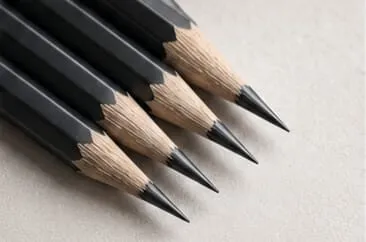
Key takeaways
- ◆H means hard and B means black: hard pencils leave paler, sharper lines, soft pencils leave darker, smoother marks.
- ◆HB is the centre of the scale and roughly matches the US number 2 pencil, though makers differ slightly.
- ◆You rarely need the full 9H to 9B range; five or six well-spaced grades cover most drawings.
- ◆The same grade looks lighter on smooth paper and darker on toothy paper, so swatch on your own surface.
- ◆Grades are not standardised across brands, so a 4B from one maker will not match a 4B from another.
Open a tin of graphite pencils and you meet a code: 4H, HB, 2B, 6B. Nobody explains it, and the numbers seem to promise precision that the pencils do not always deliver. The good news is that the system is simple once you know that it is a single sliding scale from hard and pale to soft and dark.
This guide decodes the letters and numbers, shows how grades map onto the US number system, explains what each part of the range is good for and tells you which grades are worth buying. If you want to compare tones side by side, the pencil grade chart tool will help you see the spread at a glance.
What the letters mean
Graphite pencil grades come from the H, B and F letters:
- H stands for hard. Hard pencils have a higher proportion of clay mixed with the graphite. They leave a paler, thinner line, keep a sharp point and resist smudging.
- B stands for black. Soft pencils have more graphite relative to clay. They lay down a darker, smoother mark, wear faster and smudge more readily.
- F stands for fine point and sits between H and HB. It is firm enough to hold a point and dark enough to read clearly.
- HB is the mid-point of the scale, balancing hardness and blackness.
The number in front of H or B tells you how far along the scale you are. 2H is harder than H, 4H is harder than 2H, and so on. 2B is softer and darker than B, 6B softer still. Most full sets run from about 9H (the hardest) to 9B (the softest), which is why you see the range “9H to 9B”, but many ranges stop short at either end.
It is worth remembering that the pencil core is not lead. The name survives from history, but what you are using is graphite mixed with clay, which is why you sometimes see the word “graphite” on barrels instead.
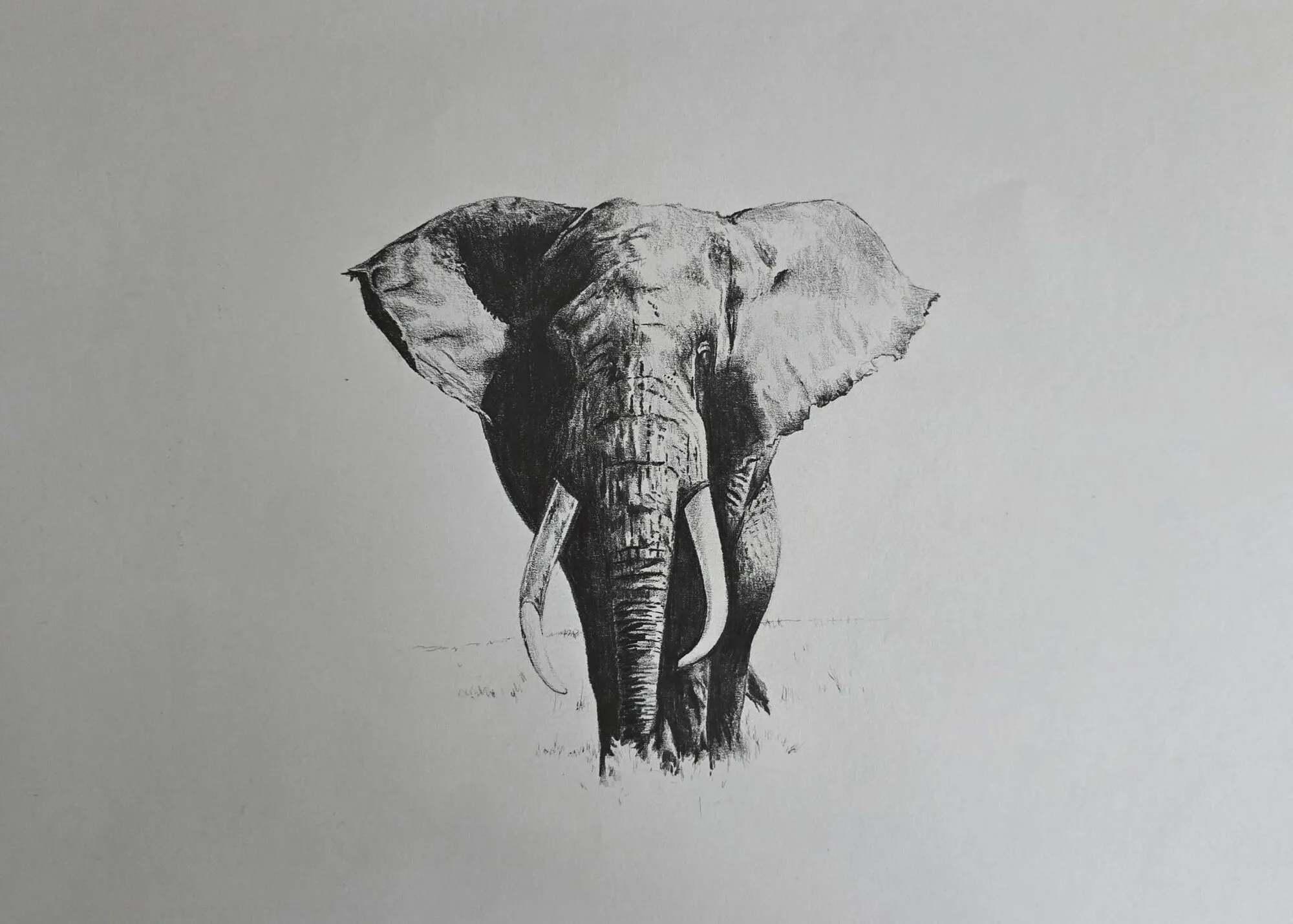
An elephant walking forward drawn in graphite pencil. Drawing by Michael Brace.
The full scale at a glance
From hardest to softest, the usual order is:
9H, 8H, 7H, 6H, 5H, 4H, 3H, 2H, H, F, HB, B, 2B, 3B, 4B, 5B, 6B, 7B, 8B, 9B.
| Range | Feel | Typical use |
|---|---|---|
| 9H to 6H | Very hard, very pale, can scratch paper | Specialist technical work, transfer, very faint guidelines |
| 5H to 2H | Hard and pale, sharp point | Layout, fine detail, pale skies, delicate tone |
| H to HB | Firm to medium | Outlines, general drawing, writing |
| B to 3B | Soft and smooth | Shading, mid-tones, most portrait work |
| 4B to 6B | Very soft, dark | Deep shadows, bold tone, expressive marks |
| 7B to 9B | Extremely soft, crumbly | Very dark areas, broad tonal masses |
Do not read the table as a strict rulebook. Manufacturers vary, and the range you actually see on a shelf depends on the brand.
US number equivalents
In the United States, pencils are often sold by number rather than letter. The commonly quoted equivalents are:
| US number | Approximate grade |
|---|---|
| 1 | B |
| 2 | HB |
| 2.5 | F |
| 3 | H |
| 4 | 2H |
The familiar yellow number 2 pencil is therefore roughly an HB. These matches are approximate and vary between makers, so treat them as a guide when you are switching between American and European products. Number pencils stop well short of the soft and very hard ends of the scale, so for drawing you will nearly always want a letter-graded set.
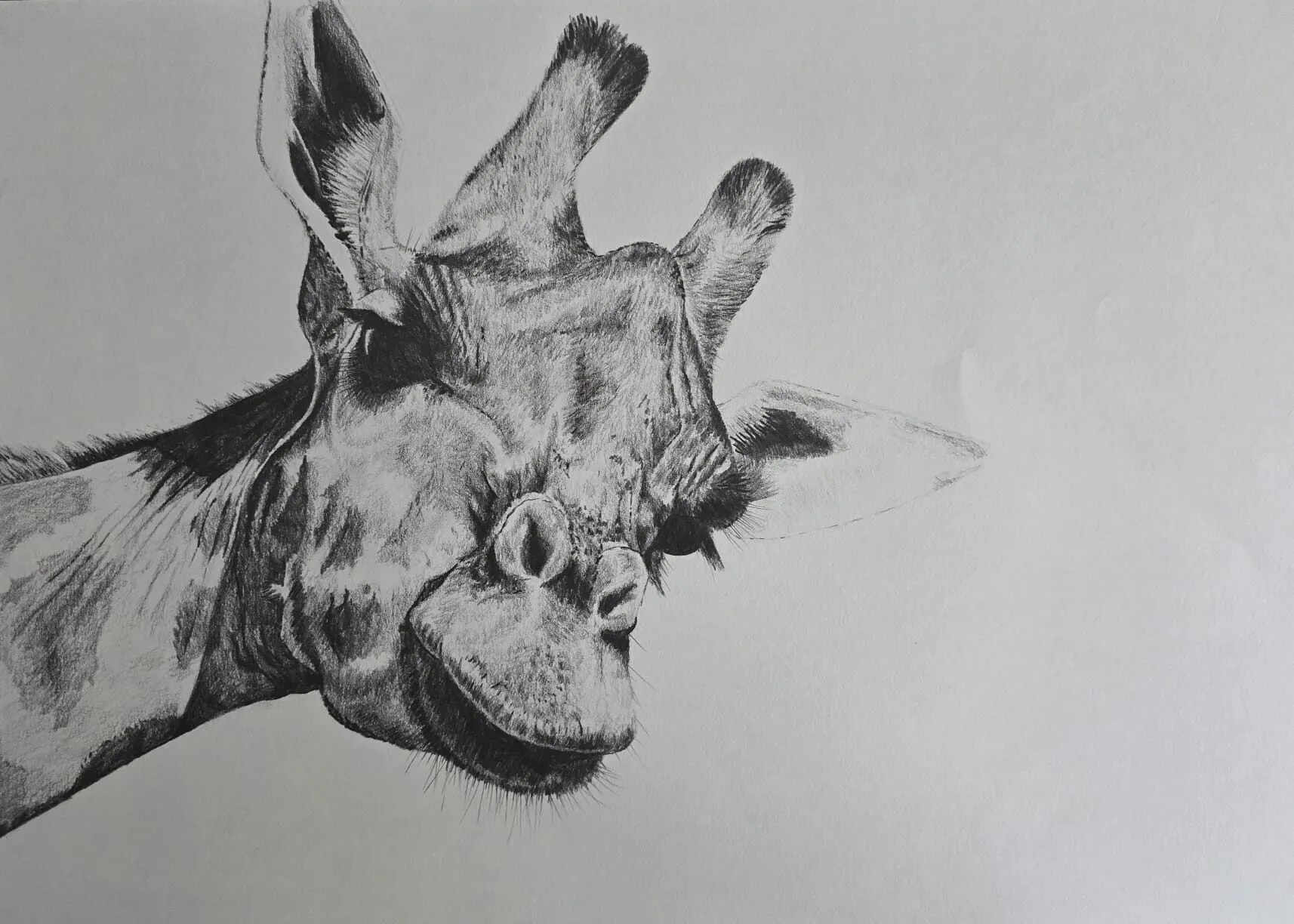
A giraffe’s head drawn in graphite pencil. Drawing by Michael Brace.
What each part of the range is good for
Hard grades: 4H to H
Hard pencils are your planning tools. They lay light lines that are easy to erase or draw over, which makes them ideal for the first stage of a drawing: proportions, outlines and light tone. They hold a fine point for a long time, so they suit small, precise areas such as the edges of a watch face or fine lettering.
The trade-off is that they cannot get very dark. Pressing harder does not create a darker line so much as an embossed groove in the paper that graphite in later layers cannot fill. This is a common beginner error: trying to force a hard pencil to do a soft pencil’s job. If you notice shiny, indented lines, the grade is too hard for the tone you want.
Mid grades: F to 2B
These are the workhorses. HB and B are good for outlines and early tone; 2B suits general shading and smooth mid-tone. On smooth paper you can build a full range from light to fairly dark with layering alone, which gives smooth, controlled results.
Soft grades: 3B to 9B
Soft pencils give dark tone quickly with light pressure, which protects the paper’s tooth and keeps textures open. They are smooth and blend easily, so they are used for shadows, deep values and expressive marks. The drawbacks are that they wear quickly, need frequent sharpening, smudge easily and can get shiny if piled up heavily.
Tone range: how dark can each grade go?
Two things determine the tone you can actually reach with a pencil: the grade and the paper. Soft grades reach deeper darks, but heavy layers of graphite of any grade will develop a slight sheen when viewed from an angle. Building dark tone with several layers of a soft pencil, and finishing with a small amount of very soft grade in the deepest areas, usually gives a richer, less shiny result than pressing one pencil hard.
A useful rule: use the softest grade that you can control, and use light pressure to get there. It is easier to add tone gradually with a 4B than to lighten a shiny, over-pressed 2B.
How grades behave on different papers
The same 2B will look different on different sheets. On smooth paper such as hot press or smooth bristol, graphite has little to grip. Marks look finer and paler, and you may need softer grades to get deep tone. Detail is easy, but the surface fills quickly and heavy layers can look slick.
On toothy paper such as cold press watercolour paper, the graphite catches on the peaks of the texture, so the same pencil gives a darker, more granular mark. Hard grades work well here because the paper provides the grip; very soft grades can look coarse and fill the valleys quickly.
Michael’s preference for graphite is paper with enough tooth for rich shadows and cross-hatching, such as Arches Cold Press and Winsor and Newton cartridge paper. Our guide to the best paper for graphite drawing covers what to look for, and smooth versus textured paper explains how tooth changes the mark.
Brand variation
There is no international standard that fixes exactly how dark a given grade should be. Two 4B pencils from different makers can differ in darkness, smoothness and how quickly they wear. Manufacturers also disagree on where their scale ends: some stop at 6B, others offer 8B or 9B, and some skip certain steps in the middle.
Two practical consequences follow. First, stick to a single brand while you are learning so that the jumps between grades feel consistent. Second, when you add a pencil from another maker, swatch it against the existing set before you use it on a drawing, and judge by the mark rather than the label.
What to buy
You do not need 20 pencils. For most drawings, a spread of five or six grades is enough:
| Grade | Job |
|---|---|
| 2H | Light layout and pale tone |
| HB | General lines and early tone |
| 2B | Main shading |
| 4B | Deeper shadows |
| 6B | Darkest areas |
Add an H or 3H if you like very light guidelines, and an 8B if you often need very deep tone. If you are choosing between sets or single pencils, our guide to the best graphite pencils for drawing covers what to look for and recommended kits by subject. A sketching set such as the Derwent Sketching pencils gives you a spread of grades in one purchase; check the manufacturer for the exact range in the set you choose.
Common grade mistakes
- Using only HB. It is comfortable, but you will press hard to get dark tone and the drawing will look shiny and flat.
- Starting with soft pencils. Soft grades make early lines dark and hard to change. Begin with a hard or mid grade for layout.
- Pressing hard with a hard pencil. This carves lines into the paper rather than making them darker.
- Trusting the label. Grades vary across brands and papers, so trust your swatch.
- Buying by range. A 9H to 9B set sounds thorough, but most of it will sit unused.
Putting grades to work
A simple structure for any drawing: begin with 2H or HB for light construction, build mid-tones with 2B and B, bring in 4B for shadows, and reserve 6B or softer for the darkest accents. Always move from harder to softer, because soft graphite over hard is easy, while hard over soft tends to skid and burnish.
Then practise. Our guide to how to shade with pencil gives a practice sequence for controlling tone with pressure, and the value study tool shows how your tones read when reduced to grey. For a bigger picture of the whole subject, return to the graphite and charcoal guide.
New to buying pencils? See the best drawing pencils for beginners, or take the which pencil set quiz.
The short version
H is hard and pale, B is soft and dark, HB sits in the middle and matches a US number 2. Buy about five grades, roughly 2H, HB, 2B, 4B and 6B, stick to one brand while you learn, and swatch on your own paper. Use the softest grade you can control, work from hard to soft, and let light layers do the work.
Where to buy
Recommended products
Affiliate links. We may earn a small commission if you buy, at no extra cost to you. Why?
Pencils · Derwent
Derwent Sketching Pencils
A graphite sketching range for tonal studies and everyday drawing.
Buy on AmazonAffiliate link · opens Amazon
Quick answers
Frequently asked questions
What is the difference between H and B pencils?+
H pencils are hard, with more clay in the core, so they leave a lighter, finer line and hold a point longer. B pencils are soft, with more graphite, so they leave a darker, smoother mark but wear down faster and smudge more easily. HB and F sit in between.
What is a number 2 pencil in H and B terms?+
In the US numbering system a number 2 pencil is generally equivalent to HB. Number 1 is roughly B, number 2.5 is roughly F and number 3 is roughly H. These are approximate equivalents, and individual makers can differ slightly.
Which pencil grades do I need for realistic drawing?+
A practical set is 2H, HB, 2B, 4B and 6B. Add a 8B or 9B only if you regularly need very dark tone, and a harder pencil such as 4H only if you draw very fine or technical work. More grades add choice, not skill.
Are all 2B pencils the same darkness?+
No. Grades are not strictly standardised, so a 2B from one brand can be a little darker or lighter than a 2B from another. Stay with one brand while you learn, and swatch any new pencil against your existing ones before starting a drawing.